


In one of the most intense and emotional stories in the Bible, Abraham is faced with the ultimate test of his faith—being asked by God to sacrifice his beloved son, Isaac. This wasn’t just a command to follow; it was a moment of surrender that would define Abraham’s trust in God forever. Can you imagine being in his shoes? After years of waiting for the son God had promised, Abraham was now asked to give him up. But as heart-wrenching as this story is, it’s also a profound lesson in faith, obedience, and trust in God’s plan. Even in 2024, when we face our own challenges, this story speaks to us about holding on to God’s promises, even when life takes an unexpected turn. So, let’s journey back to ancient times, as we explore the deeper meaning of Abraham’s ultimate test.
Setting the Stage: Abraham’s Journey of Faith
The Promise of Isaac
Years before the command to sacrifice Isaac, God had made a monumental promise to Abraham: that he would be the father of many nations. This seemed impossible at first—Abraham and his wife, Sarah, were both well past childbearing age. But despite the odds, Abraham chose to trust God. When Isaac was finally born, it wasn’t just the fulfillment of a dream; it was proof that nothing is impossible with God.
Years of Waiting
Can you imagine waiting for decades for a single promise to be fulfilled? That was Abraham and Sarah’s reality. Isaac’s birth was the culmination of years of waiting, hoping, and holding onto faith. This wasn’t just about a child—it was about God showing that His timing is perfect, even when we can’t see the full picture.
A Growing Faith Through Trials
Abraham’s journey was marked by many trials. From leaving his homeland without knowing where he was going to nearly losing his wife to a foreign king, Abraham learned that faith was built step by step, through trust and obedience. These experiences shaped Abraham, preparing him for the biggest test of his life: offering Isaac as a sacrifice.
Abraham’s journey was one of faith, obedience, and waiting on God’s promises. Little did he know that the ultimate test of his faith was just around the corner.
The Shocking Command: God’s Request to Sacrifice Isaac
God’s Unthinkable Instruction
Out of the blue, God commanded Abraham to sacrifice his only son, Isaac, the very child He had promised would be the beginning of countless descendants. The shock of such a request is hard to imagine. This wasn’t just about losing a child; it felt like the very foundation of God’s promise was being pulled out from under him. Why would God ask this? It didn’t seem to make sense. Yet, Abraham didn’t question God’s plan—he obeyed without hesitation.
The Weight of Obedience
Imagine the emotional and mental weight Abraham must have carried. The Bible doesn’t describe Abraham as wavering or arguing, but it’s impossible to ignore the depth of the sacrifice he was asked to make. Abraham, a loving father, had to walk for days knowing what God had asked him to do. Can you picture his inner turmoil? Yet, through it all, Abraham showed remarkable trust, not just in God’s command but in God’s character.
Faith Beyond Understanding
Abraham’s faith at this moment was not about understanding God’s ways, but about trusting Him entirely. In Hebrews 11:19, we’re told that Abraham reasoned that God could raise the dead. This shows that Abraham’s faith in God’s goodness was so strong, he believed even if Isaac died, God could bring him back to life. That’s faith beyond logic. Abraham wasn’t trusting in his own understanding of the situation—he was trusting in God’s ability to redeem any circumstance.
The Journey to Moriah: A Walk of Silent Faith
A Three-Day Journey
As Abraham set out for Mount Moriah, the Bible tells us it took three days to reach the place God had designated. Three long days of walking alongside his beloved son, knowing what was coming. Imagine the tension in his heart, the silence that must have filled the air, and the constant internal battle. Yet, through it all, Abraham pressed on. His outward actions—packing the wood, bringing the knife—reflected his inward commitment to trust God, even in the darkest of moments.
Isaac’s Innocent Question
At one point during the journey, Isaac noticed something was missing. “Father,” he asked, “where is the lamb for the burnt offering?” (Genesis 22:7). This question must have pierced Abraham’s heart. His response, though, was filled with quiet faith: “God Himself will provide the lamb.” Abraham’s words showed that even in the midst of this impossible situation, he clung to the belief that God would somehow intervene. He couldn’t see the full picture, but he trusted that God’s provision was on the horizon.
The Altar Is Built: A Heart-Wrenching Moment
Building the Altar
As they reached the place God had shown him, Abraham began to build the altar. Every stone placed must have felt like a heavy weight on his soul. Each action was a step toward obedience, even though it meant laying down the very thing he held most dear. Abraham’s hands were busy constructing the altar, but his heart was likely wrestling with the enormity of what he was about to do. This was no small act of faith—it was a radical display of devotion.
Isaac’s Submission
What’s remarkable about this moment is Isaac’s own willingness. The Bible doesn’t record any struggle or resistance from him. Isaac, who was likely a young man at this point, allowed his father to bind him and place him on the altar. His submission reflects not only trust in his father but also in God. Isaac, much like Abraham, was walking in faith, believing that somehow, some way, God would remain true to His promises.
Abraham Raises the Knife: The Ultimate Act of Obedience
The Moment of Truth
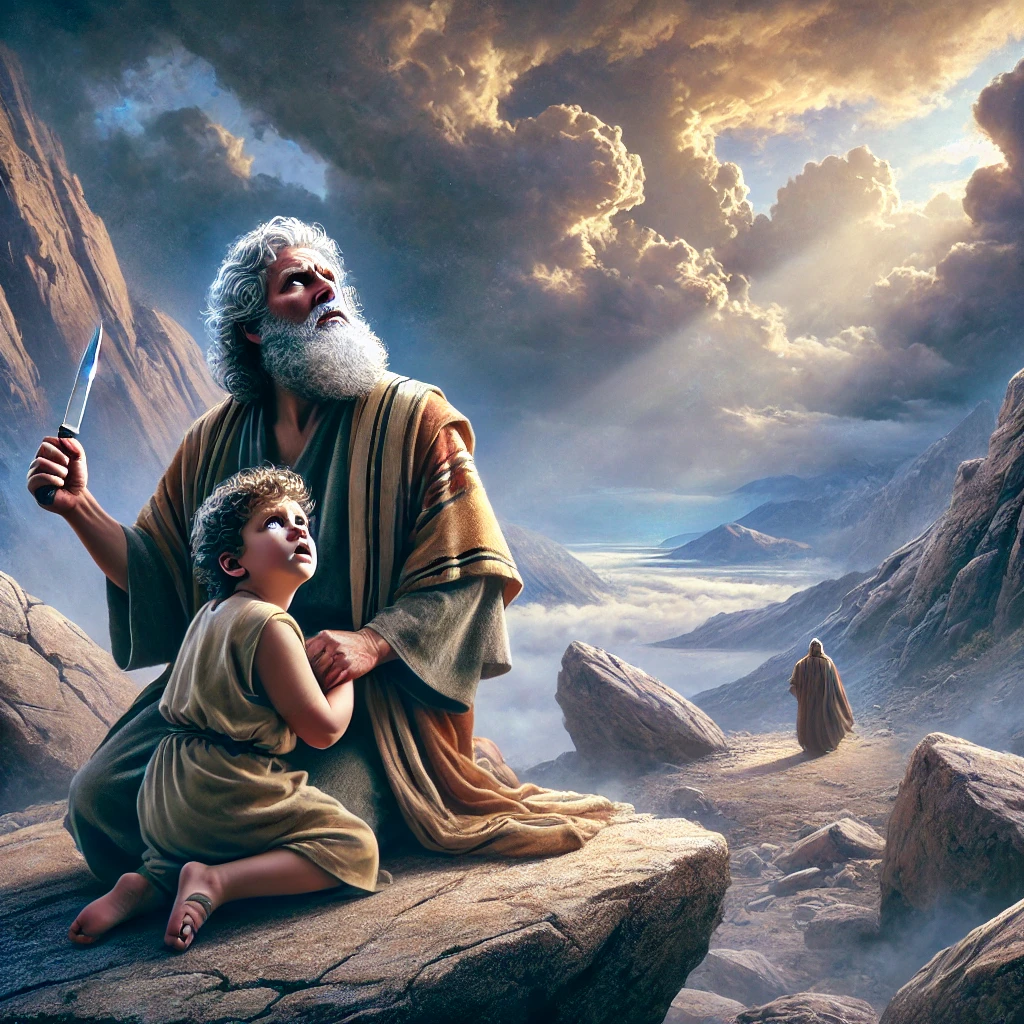
With Isaac bound on the altar and the wood ready for the sacrifice, Abraham raised the knife. Can you imagine the weight of this moment? Everything slowed down to a crawl, and the silence must have been deafening. This was the culmination of Abraham’s faith—his willingness to sacrifice the son of promise, the child through whom God’s covenant was meant to be fulfilled. Yet, despite all logic and emotion screaming to stop, Abraham was ready to obey God fully. He didn’t understand how God’s promises would still come to pass, but he trusted that somehow, even in this, God’s plan was perfect.
A Test Passed in Faith
At the very last second, just as Abraham was about to bring the knife down, an angel of the Lord called out, “Do not lay a hand on the boy!” (Genesis 22:12). What a moment of relief and divine intervention! God had seen Abraham’s heart, his willingness to hold nothing back, even his beloved son. Abraham’s obedience had passed the ultimate test, showing that his faith in God was greater than anything else—even the love for his own child. This was not just a test of obedience; it was a declaration of Abraham’s unshakable trust in God’s character and promises.
God Provides the Ram: A Picture of Substitution
The Ram in the Thicket
As Abraham looked up, he saw a ram caught in a thicket by its horns (Genesis 22:13). This was God’s provision—an alternative sacrifice that spared Isaac’s life. The ram became the substitute, pointing ahead to the greater substitutionary sacrifice of Jesus Christ. Abraham named that place “The Lord Will Provide” (Yahweh Yireh), a testament to God’s faithfulness in the most desperate moments. This wasn’t just a personal victory for Abraham; it was a foreshadowing of God’s ultimate provision for humanity through Christ.
God’s Plan for Redemption
This moment on Mount Moriah serves as a prophetic picture of what God Himself would do thousands of years later. Just as Abraham was willing to sacrifice his son, God would one day offer His own Son, Jesus, as the perfect sacrifice for the sins of the world. But unlike Isaac, there would be no last-minute substitution for Jesus. He would willingly go to the cross in our place, fulfilling the ultimate plan of redemption. The parallels between Isaac’s near-sacrifice and Jesus’ crucifixion are striking, reminding us of the depth of God’s love and the extent of His provision.
The Covenant Reaffirmed: Blessings for Generations
God’s Promises Renewed
After the dramatic test of faith, God reaffirmed His covenant with Abraham in a powerful way. In Genesis 22:15-18, the angel of the Lord called out again, declaring that because Abraham had not withheld his son, his only son, God would richly bless him. The promise was now sealed with a deeper assurance—Abraham’s descendants would be as numerous as the stars in the sky and the sand on the seashore. Through his offspring, all nations of the earth would be blessed. This was not just a reward for obedience but a confirmation of the enduring, generational impact of Abraham’s faith.
The Impact of One Act of Faith
It’s incredible to think that one man’s faith, displayed on a single mountain, would echo through the ages. Abraham’s willingness to trust God’s plan, even when it seemed impossible, laid the foundation for the coming of the Messiah, through whom all nations would be blessed. This act of faith wasn’t just about personal blessings for Abraham and his family—it had cosmic significance that pointed to the salvation of the world through Jesus. The test may have ended, but the ripple effect of Abraham’s obedience would shape the future of humanity.
Isaac’s Role in God’s Plan: The Legacy of Faith
Isaac’s Experience and Faith
Though Isaac’s part in the story is sometimes overlooked, we can’t ignore what this moment must have meant for him. Isaac wasn’t a passive participant—he carried the wood for the offering, and he must have been aware of what was happening as his father tied him to the altar. This experience likely left a deep imprint on Isaac’s faith journey, as he saw firsthand his father’s obedience and God’s provision. Isaac’s life would carry the weight of this legacy, and he would continue the covenant promises given to Abraham.
The Next Generation of Faith
Isaac’s survival and his future were essential to the fulfillment of God’s promises to Abraham. Isaac would go on to father Jacob, who would be the patriarch of the twelve tribes of Israel. The story of faith passed down from Abraham to Isaac and beyond is a testament to the importance of generational faithfulness. Isaac’s life, marked by this defining moment on the mountain, reminds us that God’s promises are not just for one person but for future generations. Faith, obedience, and trust in God’s plan don’t just affect our lives—they shape the destiny of those who come after us.
The Ram in the Thicket: God’s Provision in the Moment of Need
God’s Miraculous Provision
Just as Abraham raised the knife to sacrifice Isaac, God intervened. In Genesis 22:13, Abraham looked up and saw a ram caught in the thicket by its horns. God had provided a substitute offering at the exact moment it was needed. This wasn’t a coincidence—God had prepared the ram all along, waiting for the precise moment when Abraham’s faith had been fully tested. The provision of the ram points to God’s faithfulness and His ability to provide in ways we can’t foresee, even in our most desperate circumstances.
The Foreshadowing of Christ
The image of the ram as a substitute for Isaac has profound significance. It points forward to the ultimate sacrifice that God would make on behalf of humanity. Just as the ram took Isaac’s place, Jesus would later take our place, dying as the ultimate sacrifice for our sins. Abraham’s statement, “The Lord will provide” (Genesis 22:14), was prophetic, pointing not only to God’s immediate provision but also to His eternal plan for salvation through Christ. This moment on Mount Moriah foreshadowed the sacrifice of Jesus on the cross—God’s provision for the salvation of the world.
Mount Moriah: The Place of Testing and Future Significance
Mount Moriah’s Role in Biblical History
Mount Moriah wasn’t just the location of Abraham’s test; it holds great significance throughout the Bible. This mountain would later become the site where Solomon built the Temple in Jerusalem (2 Chronicles 3:1). The very place where Abraham’s faith was tested would become the center of Jewish worship for centuries, symbolizing God’s ongoing relationship with His people. It’s a reminder that places of testing and trial can become places of deep spiritual significance.
The Parallels with Jesus’ Sacrifice
Mount Moriah also foreshadows another monumental event: Jesus’ crucifixion. Many scholars believe that the region of Moriah is near the location where Jesus was crucified, further deepening the connection between Abraham’s willingness to sacrifice Isaac and God’s willingness to sacrifice His Son. Abraham’s test on Mount Moriah becomes a powerful symbol of ultimate faith, trust, and sacrifice, prefiguring God’s ultimate act of love on the cross.
The Ram in the Thicket: God’s Provision in the Eleventh Hour
God’s Perfect Timing
Just as Abraham was about to sacrifice Isaac, an angel of the Lord intervened, and a ram caught in a thicket appeared (Genesis 22:11-13). This moment not only revealed Abraham’s unwavering faith but also highlighted God’s perfect timing. Often, God’s provision arrives when we least expect it, and in this instance, it came at the very last moment. The ram became the substitute for Isaac, showcasing God’s grace and mercy. In our lives, we too face situations where it seems all hope is lost, but the story of the ram teaches us that God’s provision is always on time, even in the eleventh hour.
The Symbolism of the Ram
The ram’s appearance symbolizes substitutionary atonement, a concept that would later be fulfilled in Christ. Just as the ram took Isaac’s place, Jesus became the sacrificial Lamb for humanity’s sins. This theme of substitution resonates throughout the Bible, reminding us that God provides a way when there seems to be none. Abraham named the place “The Lord Will Provide” (Genesis 22:14), signifying that God’s provision is eternal and trustworthy.
The Aftermath: Abraham’s Blessing and God’s Promise Reaffirmed
God’s Reaffirmation of His Covenant
After the intense and heart-wrenching test of faith, God reaffirmed His covenant with Abraham. In Genesis 22:16-18, God not only reiterates His promise to make Abraham the father of many nations, but He also expands it. This moment was pivotal—Abraham’s faith had not only passed the ultimate test, but it also unlocked new blessings. God promised to bless Abraham and his descendants abundantly, making them as numerous as the stars in the sky and the sand on the seashore. The obedience Abraham demonstrated was directly linked to the unfolding of God’s plan for his lineage, and through him, the blessing extended to all nations.
A Legacy of Faith
The story of Isaac on the altar stands as a towering example of what it means to trust God, even when His plans seem utterly impossible to understand. Abraham’s faith left a legacy, not just for his descendants, but for every believer who reads his story today. His actions set a powerful precedent: when we trust God with everything, even what we hold most dear, He responds with grace, provision, and blessing beyond our comprehension. The spiritual lineage of Abraham continues through those who, like him, choose to live by faith.
Isaac’s Role: Trust and Submission
Isaac’s Trust in His Father and in God
Though much of the focus is often on Abraham, Isaac’s role in this story is equally significant. The Bible doesn’t record any resistance from Isaac when he was bound and placed on the altar. Isaac’s trust in his father was remarkable, reflecting a parallel trust in God’s plan. His submission to being sacrificed shows a quiet, profound faith—mirroring Christ’s willingness to lay down His life. Isaac’s obedience is a reminder that sometimes we are called to submit to God’s plan, even when we don’t fully understand it, trusting that His will is good.
A Foreshadowing of Christ’s Sacrifice
The parallels between Isaac’s near-sacrifice and Jesus’ ultimate sacrifice are unmistakable. Isaac carried the wood for his own sacrifice, just as Christ would later carry the cross. Abraham’s willingness to give up his son mirrors God’s own willingness to give up His only Son for the salvation of the world. Isaac’s deliverance from death by the ram in the thicket foreshadows the substitutionary atonement of Christ, where Jesus took our place, offering Himself as the ultimate sacrifice for sin. This connection makes the story of Isaac on the altar even more profound in its prophetic significance.
What We Learn from Abraham’s Test: Faith in Action
Radical Obedience and Trust
Abraham’s journey to the mountain with Isaac shows us that faith is not merely intellectual—it’s active and often requires sacrifice. His willingness to obey God, even when it meant giving up his beloved son, is the pinnacle of radical trust. The lesson here is clear: true faith is demonstrated through action. Abraham didn’t just believe God in his heart; he followed through with obedient steps, even in the face of overwhelming emotional cost. In our lives today, we are often called to trust God with our most precious things, whether they are dreams, relationships, or personal desires. Faith is trusting God’s goodness, even when we can’t see how things will work out.
God’s Faithfulness in Testing Times
While this story centers on Abraham’s faith, it also highlights God’s faithfulness. God did not allow Abraham to lose his son, and He provided a substitute just in time. This shows that God never calls us to sacrifice something without having a greater purpose or provision in mind. When we are in seasons of testing, we can trust that God is faithful. His plans for us are always for our good, even when the road is difficult.
Conclusion: A Call to Faith and Sacrifice
The story of Abraham and Isaac on the altar is a timeless reminder of what it means to live a life of faith and obedience. Abraham’s ultimate test—being willing to sacrifice his son—points us to the depth of trust that God calls us to. It’s a faith that requires surrender, but also promises the blessings of God’s provision and purpose.
Just like Abraham, we are all on a journey of faith, and there will be moments when God asks us to trust Him with what we hold most dear. The good news is that, just like Abraham, we can trust God to provide in ways we never imagined. As we walk in obedience, we can be confident that God’s faithfulness will never fail, and His blessings will always follow our acts of faith.
So, what “Isaac” are you holding onto today? Is God calling you to surrender something in your life? Remember, the God who provided a ram for Abraham will also provide for you. When you trust Him fully, you’ll discover that He is always faithful, always good, and always ready to bless those who trust in Him.
Embracing Faith Like Abraham
Abraham’s ultimate test of faith is a powerful reminder of the kind of trust God calls us to. But this wasn’t the only moment when Abraham had to lean on his faith in God’s promises. Throughout his life, Abraham continually demonstrated a deep trust in God, even when the path ahead seemed unclear. If you want to explore more about how Abraham embraced God’s calling and navigated his journey of faith, check out Faith Like Abraham: How to Embrace God’s Calling in 2024. You’ll discover practical insights on living a life that follows God’s call with unwavering faith, just like Abraham did.
Further Exploration
To deepen your understanding of Abraham’s test of faith and its significance, we recommend reading “Twelve Tests of Abraham” on Bible.org. This insightful article explores not only the sacrifice of Isaac but also eleven other instances where Abraham’s faith was tested. It provides a comprehensive view of Abraham’s spiritual journey and offers practical applications for modern believers.
Read the full article here: Twelve Tests of Abraham
FAQ: Understanding Abraham’s Test of Faith
Q: What is the significance of Isaac’s story on the altar?
A: Isaac’s story on the altar is significant as it represents a test of Abraham’s faith and obedience to God. It is a powerful narrative that has been interpreted to symbolize ultimate trust in divine will and the notion of sacrifice.
Q: How does this story impact the concept of faith in Christianity?
A: This story is pivotal in Christianity as it illustrates the depth of faith required to follow God’s commands, even when they seem incomprehensible. It’s often cited as an example of unwavering faith and total surrender to God’s plan.
Q: Where can I find this story in the Bible?
A: The story of Abraham and Isaac can be found in the Book of Genesis, chapter 22, verses 1-19.
Q: Did Abraham actually sacrifice Isaac?
A: No, Abraham did not sacrifice Isaac. As Abraham prepared to carry out the sacrifice, an angel of the Lord stopped him, and a ram was provided as a substitute offering, signifying God’s provision.
Q: What lessons can we learn from Abraham’s willingness to sacrifice his son?
A: The lessons from this story are manifold, including the importance of faith, obedience, and the belief that God will provide. It also speaks to the concept of testing and the rewards of steadfastness in faith.
Q: How is the story of Isaac and Abraham relevant today?
A: Today, the story serves as a metaphor for facing our own challenges and the tests of faith we encounter. It reminds believers to trust in God’s plan and to be prepared to surrender what is precious to us if it serves a higher purpose.
Q: What does this story teach us about suffering and God’s purpose?
A: It teaches that suffering can be a part of God’s greater plan for growth and refinement. It also shows that what may appear as suffering can lead to greater blessings and understanding of God’s will.