Hi friend,
Have you ever stepped out in sincere obedience to follow a prompting from God—only to get hit mid-stride by an unexpected gust of hardship that made you look down at the waves and feel like you were sinking fast?
We often assume that if we are walking in the center of God’s will, the waters beneath our feet should stay calm and smooth. So when a sudden storm blows across our health, family, or finances right after we take a step of faith, panic whispers that we must have made a terrible mistake.
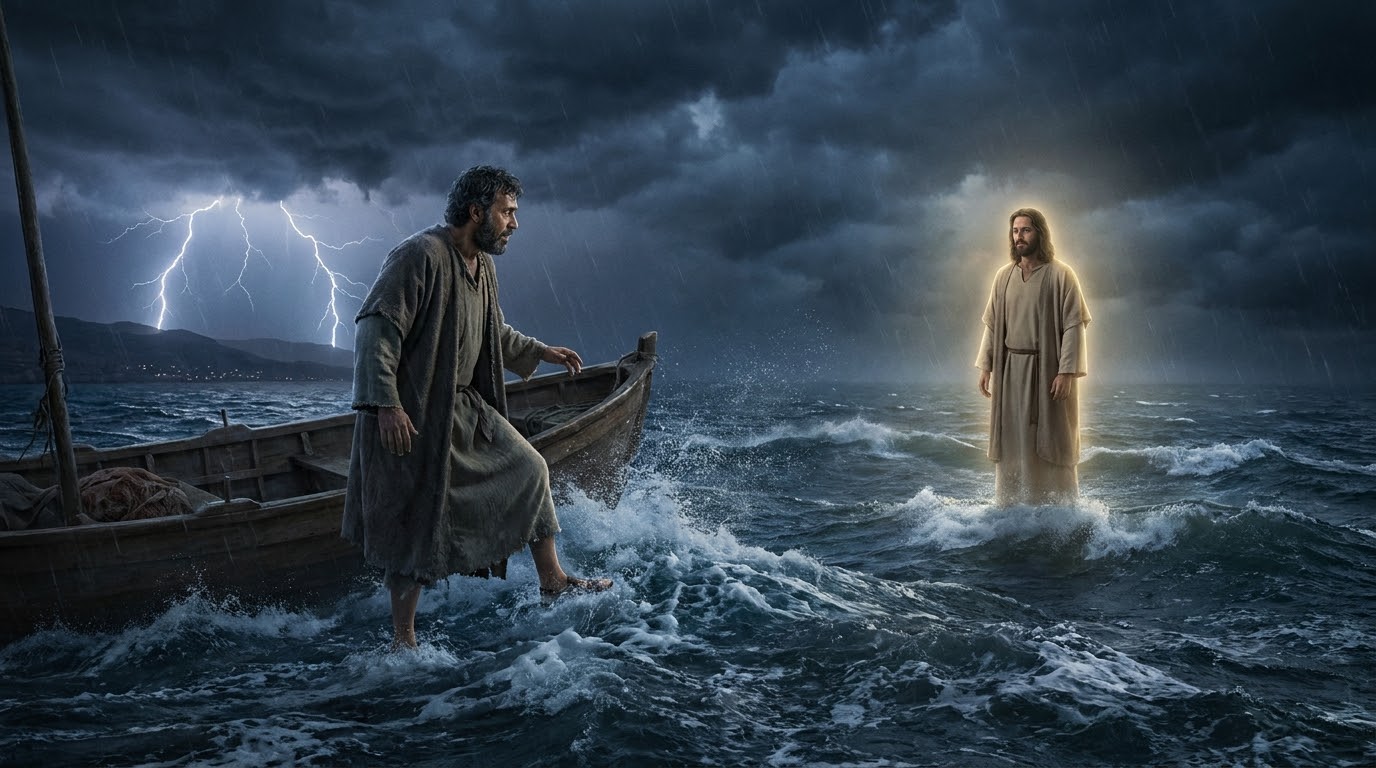
In Matthew 14:22–33, right after the miracle of feeding the five thousand, Jesus sent His disciples ahead of Him in a fishing boat across the Sea of Galilee while He went up on a mountainside alone to pray. By the darkest hours of the night—having rowed roughly 5 to 6 kilometres against a fierce headwind (John 6:19)—the exhausted disciples saw Jesus walking toward them right on top of the crashing whitecaps, setting the stage for Simon Peter’s most unforgettable step of faith.
📖 Key Biblical Passage: Matthew 14:22–33
- Matthew 14:22–24: Obeying Jesus’s direct instruction to cross the lake, the disciples find their boat buffeted by waves and contrary winds far from land.
- Matthew 14:25–27: During the fourth watch of the night (between 3:00 AM and 6:00 AM), Jesus walks on the sea and speaks peace: “Take courage! It is I. Don’t be afraid.”
- Matthew 14:28–31: At Jesus’s single word—“Come”—Peter steps out of the boat and walks on the water before looking at the wind, sinking, and being caught immediately by Jesus’s outstretched hand.
- Matthew 14:32–33: As they climb into the boat, the wind ceases instantly and the disciples worship Jesus as the Son of God.
4 Transformative Lessons from Peter Walking on Water
1. You Can Be in the Exact Center of God’s Will and Still Hit a Storm
Notice why the disciples were out on that storm-tossed lake in the first place: unlike Jonah running away from God’s call, the disciples were in that boat because Jesus Himself had insisted they get in and cross to the other side (Matthew 14:22)!
Even more comforting, Mark’s Gospel adds a precious detail in Mark 6:48: while Jesus was praying up on the mountain, He saw the disciples straining at the oars through the darkness! Even when it feels like you have been rowing against the wind until 3:00 in the morning, your Intercessor sees every stroke and comes walking to meet you right across the very waves you fear.
2. “Come”: Stepping Out of the Boat on the Authority of Jesus’s Word
People love to tease Peter for sinking, yet let’s never forget that eleven other disciples stayed huddled behind the wooden rails of the boat—and only Peter had the hunger and boldness to step over the edge!
Notice also that Peter didn’t jump into the sea out of reckless presumption. First, he asked the Lord to command him to come (Matthew 14:28), and he waited until Jesus spoke the single, authoritative invitation: “Come” (verse 29). Peter wasn’t walking on physical water so much as he was walking on the solid bedrock of Jesus’s spoken Word.
3. Whatever Holds Your Gaze Shapes Your Peace
Look carefully at Matthew 14:29–30. For several miraculous steps, a rugged Galilean fisherman actually walked on top of deep, turbulent water toward his Savior. Why did he start to sink in verse 30? Not because the wind suddenly started blowing—the storm had been howling the entire time! He began to sink the exact moment “he saw the wind” and shifted his attention from the Master to the menace.
In your daily walk, whatever occupies your gaze will govern your emotions: when we stare at the wind and measure the height of our problems, fear swallows our confidence; when we keep our eyes locked on Jesus (Hebrews 12:2) and practice overcoming fear with faith, His presence steadies our feet.
4. A Three-Word Cry (“Lord, Save Me!”) and the Immediate Grip of Grace
When water began closing around Peter’s knees, he didn’t have time to compose a lengthy, formal prayer. He cried out a three-word emergency prayer from the depths of his heart: “Lord, save me!” (Matthew 14:30).
And look at the very next word in Matthew 14:31: “Immediately” Jesus reached out His hand and caught him! Jesus didn’t cross His arms, let Peter swallow water for five minutes to teach him a lesson, or tell him to swim back to the boat on his own. Even when Peter’s faith faltered, Jesus’s grip never slipped—and the two of them walked back into the boat together as the storm fell completely silent.
🌿 A Quiet-Time Reflection & Breath Prayer for Today
If the winds of a hard week have pulled your eyes off Jesus and made you feel like you are sinking, reach up for His outstretched hand right now:
- Inhale slowly: “Jesus, You walk right across the storms that frighten me…”
- Exhale in trust: “…I turn my eyes off the wind and rest in Your unbreakable grip.”
Keep your morning gaze anchored on Christ with our printable 30-Day Christian Prayer Journals or our Walking in Grace 52-Week Devotional.
Read Next: Peter’s Complete Journey From Fisherman to Apostle →Frequently Asked Questions About Peter Walking on Water
What was the “fourth watch of the night” in Matthew 14:25?
Under the Roman timekeeping system used in the Gospels, the night was divided into four three-hour watches from 6:00 PM to 6:00 AM. The fourth watch ran from 3:00 AM to 6:00 AM—the coldest, darkest, and most exhausting stretch just before dawn, meaning the disciples had been rowing against the storm for roughly nine hours before Jesus arrived.
What did Jesus mean by “You of little faith” in Matthew 14:31?
In Greek, “little faith” is a single compound word (oligopistos) that Jesus used affectionately with His disciples—not to say Peter had no faith (after all, he had just stepped out of the boat and walked on water!), but to gently ask why he allowed a burst of doubt to interrupt a walk of faith that had started so well.
Where is Jesus inviting you to step out of the boat and keep your eyes fixed on Him in this season? Share your thoughts in the comments below!