

Hi friend,
Have you ever felt a quiet nudge in your spirit toward a new step of obedience—leading a small group, having an honest conversation, starting a ministry project, or stepping into a new season of motherhood—only for your mind to immediately flood with reasons why you are the wrong person for the job?
Whispers of “Who am I to do this?”, “I don’t have the right words,” or “Someone more polished would do a much better job” can stop us in our tracks before we ever take a single step. We look at our past stumbles, our limited energy, and our human weaknesses, assuming that God only works through people who feel confident and put-together.
Yet throughout all of Scripture—as we see in our flagship study on the 12 Unqualified People God Used in the Bible—God delights in choosing reluctant, ordinary vessels so that His grace shines all the brighter.
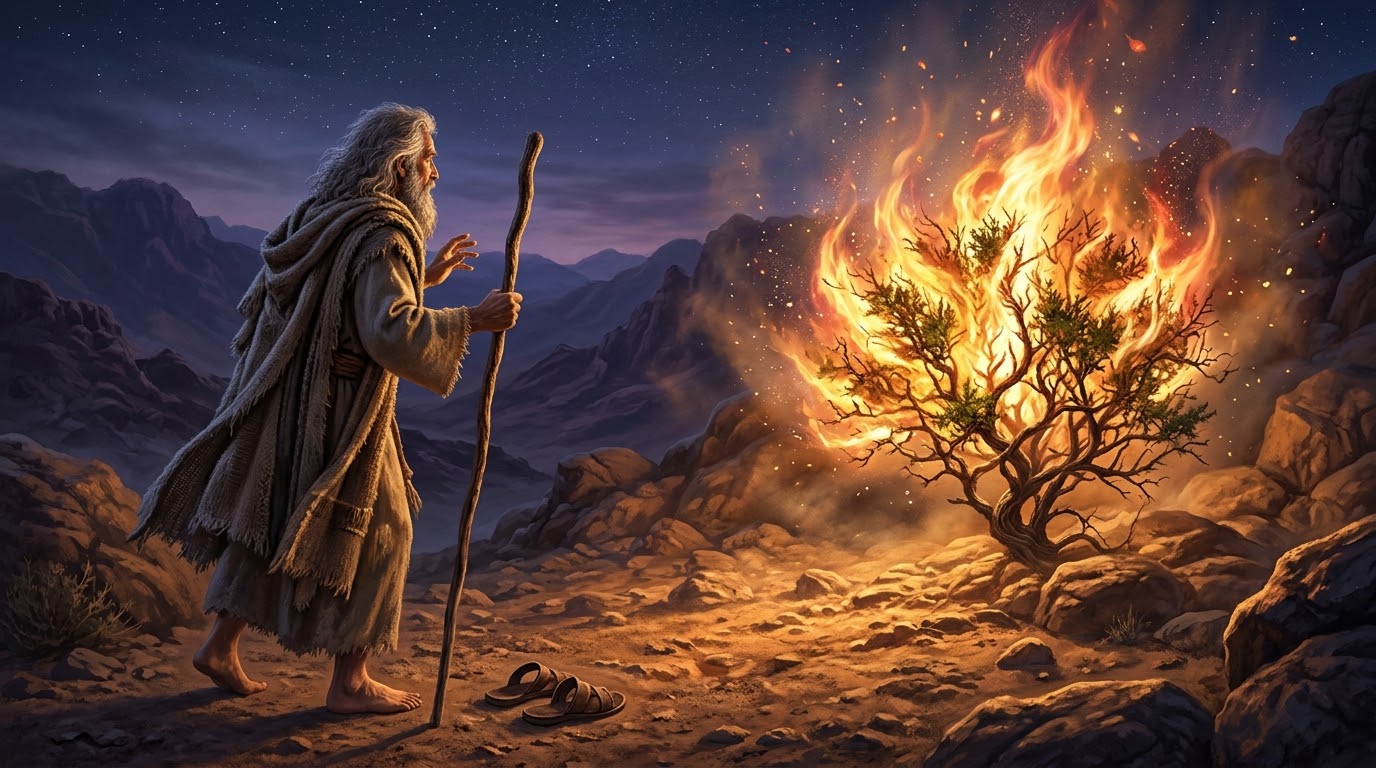
Nowhere is that tension between human insecurity and divine sufficiency clearer than in Exodus chapters 3 and 4. Standing barefoot before a desert thornbush blazing with fire yet never burning up, eighty-year-old Moses met the Living God—and immediately offered five separate excuses for why he wasn’t enough.
Let’s walk through four comforting lessons from Moses at the burning bush and see how God answers every single one of our insecurities with His unshakeable presence.
📖 Key Biblical Passage to Read Along: Exodus 3:1–4:17
The Context: Forty years after fleeing Egypt in fear and failure, Moses is tending his father-in-law Jethro’s flock on the far side of the wilderness near Horeb. Out of an ordinary thornbush, the Lord calls Moses by name, reveals His heart to rescue His suffering people, and answers Moses’s fears not with flattery, but with the promise: “I will be with you.”
1. Holy Ground in the Ordinary Desert: God Meets You Right Where You Are
Notice where Moses was when heaven interrupted his life. In Exodus 3:1–2, he wasn’t fasting inside a royal sanctuary or standing on a stage; he was working a quiet, repetitive job tending someone else’s sheep in the dusty backside of Midian. Having spent four decades in obscurity after his rash failure in Egypt, Moses likely assumed his days of significance were long behind him.
Yet it was right in the middle of an ordinary workday that the angel of the Lord appeared in flames of fire from within a scrubby desert bush. When Moses turned aside to look, God called him twice by name—“Moses, Moses!”—and invited him to remove his sandals because the ground beneath his tired feet had become holy ground.
What this means for your walk today: You do not have to wait until your schedule is spotless, your house is quiet, or your spiritual resume feels impressive for God to meet with you. What makes ground “holy” is never the perfection of the surroundings—it is the presence of the Lord. As we trace in our complete biblical guide to the Book of Exodus, God frequently uses hidden wilderness seasons to quiet our pride and prepare our hearts for true deliverance.
2. Breaking the “Who Am I?” Trap: Shifting Your Gaze to “I AM”
The moment the Lord commissioned Moses to go back to Pharaoh and lead the Israelites out of slavery, Moses voiced the exact question so many of us whisper in prayer: “Who am I that I should go?” (Exodus 3:11).
Look closely at how God responded in Exodus 3:12–14. God did not hand Moses a list of self-esteem affirmations. He didn’t say, “Moses, you are eloquent, royal-educated, and strong enough to handle Pharaoh.” Instead, the Lord redirected Moses’s attention entirely away from himself and onto God’s own character: “Certainly I will be with you.”
When Moses pressed further, asking what name he should give the people of Israel, God revealed His covenant name—I AM WHO I AM (Yahweh)—the eternal, self-existent One who never runs dry.
- Insecurity asks: “Who am I? Do I have enough wisdom, energy, or courage?”
- Faith answers: “Who is God? And is His presence enough to sustain me today?”
Whenever you catch yourself spiraling in self-doubt, remember that answering God’s call has never depended on who you are in your own strength—it rests entirely on Who walks beside you.
3. “What Is in Your Hand?”: God Anoints the Ordinary Tools You Already Hold
Still worried that the elders of Israel wouldn’t believe him, Moses asked in Exodus 4:1, “What if they do not believe me or listen to me?” Rather than handing Moses a gleaming sword or a royal scepter from heaven, the Lord asked a remarkably simple question in Exodus 4:2: “What is that in your hand?”
All Moses held was a weathered wooden shepherd’s staff—an ordinary piece of wood he used every day to guide stubborn sheep, lean on when his legs were weary, and ward off desert predators. Yet when Moses threw that ordinary stick on the ground in obedience to God’s command, God infused it with supernatural authority. That humble piece of wood became the “staff of God” lifted over the Red Sea and used to strike the rock in the wilderness (see our study on the 7 Miracles of Moses and Divine Signs).
What this means for your walk today: God never asks you to bring talents, personality traits, or resources you don’t possess. Instead, He asks, “What is already in your hand?” Whether it is a listening ear for a hurting neighbor, a kitchen table where you welcome your family, or a quiet habit of intercessory prayer, when you lay your ordinary gifts at Jesus’s feet, He multiplies them beyond anything you could orchestrate on your own.
4. When You Feel Slow of Speech: God Provides Both Grace and Community
Even after seeing the miraculous signs of the staff and his healed hand, Moses offered his most vulnerable excuse in Exodus 4:10—confessing that he had never been eloquent and felt slow of speech and tongue. Finally, in Exodus 4:13, Moses pleaded outright: “Pardon your servant, Lord. Please send someone else.”
Notice the two ways the Lord met Moses in that moment of raw fear:
- The Creator’s Promise: God reminded Moses in Exodus 4:11–12 that the One who fashioned the human mouth, eyes, and ears is more than able to teach us what to say in the exact hour we need it.
- The Gift of Shared Burden: God appointed Moses’s brother Aaron—who was already on his way through the desert—to walk alongside him as a supportive partner and spokesman (read more in our reflection on Moses and Aaron: 9 Timeless Lessons on Faith and Brotherhood).
God never intended for you to carry your calling in isolation. When a step of obedience feels too heavy for your shoulders alone, He faithfully brings Aaron-like friends, mentors, and helpers alongside you to share the weight.
🌿 A Quiet-Time Reflection & Breath Prayer for Today
Before you rush into the rest of your day, take a slow, deep breath and release the pressure to feel “qualified” in your own strength:
- Inhale slowly: “Lord, in my own strength I am not enough…”
- Exhale in peace: “…but You are the great I AM, and You go with me.”
Want a peaceful place to write down what God is speaking to your heart in this season? Explore our collection of 30-Day Christian Prayer Journals or dive deeper into Exodus with our Walking in Grace 52-Week Devotional.
Read Next: 12 Unqualified People God Used in the Bible →Frequently Asked Questions About Moses at the Burning Bush
Why did the burning bush not burn up in Exodus 3?
Biblical commentators note that the unconsumed flame symbolized God’s self-sustaining holiness and eternal power—He does not depend on earthly fuel to shine. It also served as a visual promise to Israel: though God’s people were walking through the fiery furnace of Egyptian affliction, God was in their midst and would not allow them to be destroyed.
How old was Moses when God called him at the burning bush?
According to Exodus 7:7 and Acts 7:23–30, Moses spent his first 40 years as a prince in Egypt, his next 40 years as a shepherd in Midian, and was 80 years old when God spoke to him from the burning bush—proving it is never too late for God to begin a new chapter in your life!
Which of Moses’s excuses at the burning bush do you relate to most in your own walk of faith? Share your thoughts in the comments below so we can pray for and encourage one another!

