Hi friend,
What does it really look like to live a “blessed” life? If you scroll through social media today, the hashtag #blessed is almost always attached to a picture of material comfort, a promotion, a vacation, or a season where everything is going smoothly.
Yet if “blessed” only meant having an easy, pain-free week, what would happen to our joy when grief, conflict, or financial strain arrived at our door?
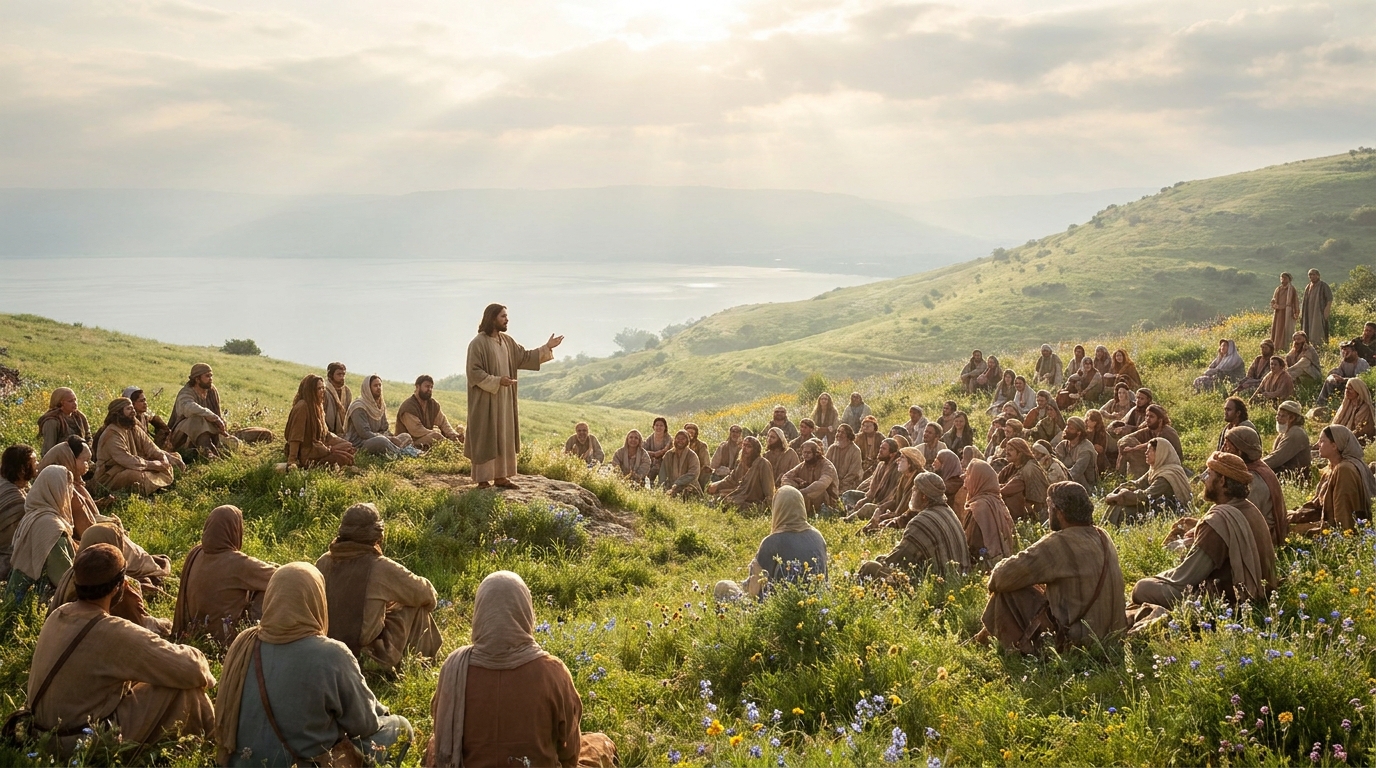
Sitting down on a grassy hillside overlooking the northern shore of the Sea of Galilee in Matthew 5:1–12, Jesus opened the greatest sermon ever preached—the Sermon on the Mount—with eight counter-cultural declarations known as The Beatitudes (from the Latin word beatitudo, meaning supreme blessedness). In just ten verses, Jesus turned the world’s ladder of success upside down, showing us that heaven’s deepest favor rests on the humble, the hurting, and the merciful.
📖 Quick Reference: The 8 Beatitudes & Their Promises (Matthew 5:3–10)
- The Poor in Spirit (Verse 3): Those who recognize their spiritual need without pride $\rightarrow$ Theirs is the kingdom of heaven.
- Those Who Mourn (Verse 4): Those who grieve over brokenness and sorrow $\rightarrow$ They shall be comforted.
- The Meek (Verse 5): Those whose strength is surrendered under God’s gentle control $\rightarrow$ They shall inherit the earth.
- Those Who Hunger & Thirst for Righteousness (Verse 6): Those who crave right standing and intimacy with God $\rightarrow$ They shall be filled.
- The Merciful (Verse 7): Those who extend active compassion and forgiveness $\rightarrow$ They shall obtain mercy.
- The Pure in Heart (Verse 8): Those with an undivided, sincere heart toward God $\rightarrow$ They shall see God.
- The Peacemakers (Verse 9): Those who actively build bridges of reconciliation $\rightarrow$ They shall be called children of God.
- The Persecuted for Righteousness’ Sake (Verse 10): Those who suffer for remaining faithful to Christ $\rightarrow$ Theirs is the kingdom of heaven.
4 Transformative Lessons from the Beatitudes for Daily Life
1. What “Blessed” (*Makarios*) Really Means—And Why It Starts With Empty Hands (Matthew 5:3–4)
In the original Greek of Matthew 5, the word translated “blessed” nine times in a row is makarios. Unlike our English word “happy” (which comes from the old root hap, meaning luck or happenstance—feeling good when circumstances happen to go your way), makarios describes a deep, unshakeable spiritual flourishing anchored in God’s approval that no outside storm can steal.
And notice how the Beatitudes build on one another like steps on a staircase, beginning in Matthew 5:3 with being “poor in spirit.” Greek had two different words for poor: one meant a working person living paycheck to paycheck (penes), while the word Jesus chose here—ptochos—meant someone completely destitute who had zero resources of their own and had to rely 100% on the mercy of another! The Christian life always begins the moment we drop our spiritual resume, mourn over our brokenness (verse 4), and come to Jesus with empty hands.
2. Biblical Meekness: Power Under the Master’s Rein (Matthew 5:5–6)
Few biblical words are as misunderstood today as the word “meek” in Matthew 5:5. Modern ears hear “meek” and picture someone timid, spineless, or easily pushed around. Yet in classical Greek, the adjective praus (meek) was an equestrian term used to describe a powerful warhorse that had been trained to respond instantly to the slightest touch of its rider’s reins!
The warhorse hadn’t lost an ounce of its muscle—its strength was simply brought under the Master’s gentle control (just as Numbers 12:3 describes Moses as the meekest man on earth, even while confronting Pharaoh and leading millions through the wilderness!). When we surrender our need to control outcomes and instead hunger and thirst after God’s righteousness (verse 6), Jesus promises that we will be filled to overflowing.
3. An Undivided Heart That Sees God & Extends Mercy (Matthew 5:7–8)
Notice what happens once the first four Beatitudes empty us and fill us with God’s grace: the next four Beatitudes immediately overflow outward toward the people around us! Because we have received mercy at the cross, we become merciful toward others who stumble (verse 7; see our guide on the healing power of forgiveness).
Then in Matthew 5:8, Jesus promises that the pure in heart shall see God. In Greek, katharos (“pure”) meant grain that had been winnowed free of chaff, or silver refined free of alloy—a heart that is unmixed and single-minded rather than divided between pleasing God and impressing the crowd (like the Pharisees Jesus warns against in chapter 6).
4. Peace-*Makers*, Not Just Peace-*Keepers* (Matthew 5:9–12)
Look carefully at the wording of the seventh Beatitude in Matthew 5:9: Jesus did not say, “Blessed are the peace-lovers” or “Blessed are the peace-keepers who avoid hard conversations and sweep tension under the rug.” He said: “Blessed are the peacemakers, for they shall be called children of God.”
Why does active peacemaking identify us as children of our Heavenly Father? Because God Himself is the ultimate Peacemaker—who sent His Son to make peace through the blood of His cross (Colossians 1:20)! When we bring the calming presence, honesty, and reconciling grace of Jesus into a tense room—and stand firm in love even when misunderstood or reviled for our faith (verses 10–12)—we bear the unmistakable family resemblance of our Father in heaven.
🌿 A Quiet-Time Reflection & Breath Prayer for Today
Which of the eight Beatitudes is the Holy Spirit highlighting for your heart this week? Pause and welcome Jesus’s upside-down kingdom peace into your soul:
- Inhale slowly: “Jesus, I come to You poor in spirit and hungry for Your presence…”
- Exhale in peace: “…fill my heart with Your mercy and make me a peacemaker in my home.”
Meditate through the Sermon on the Mount one morning at a time inside our 30-Day Christian Prayer Journals or our Walking in Grace 52-Week Devotional.
Read Part 2 Next: The Sermon on the Mount Antidotes for Anxiety (Matthew 6) →Frequently Asked Questions About the Beatitudes
Why do the first and eighth Beatitudes have the exact same promise?
In both the first Beatitude (Matthew 5:3, the poor in spirit) and the eighth Beatitude (Matthew 5:10, those persecuted for righteousness), Jesus gives the exact same present-tense promise: “for theirs is the kingdom of heaven” (while Beatitudes 2 through 7 use the future tense, “they shall…”). In biblical literature, this bookend structure (called an inclusio) shows that every blessing in between belongs to the present and future reality of God’s kingdom!
How does Moses on Mount Sinai compare to Jesus in the Sermon on the Mount?
Matthew deliberately structured his Gospel to show Jesus as the greater Moses: whereas Moses went up Mount Sinai amid thunder and fire to receive the stone tablets of the Law, Jesus went up the Galilean hillside, sat down in grace among His disciples, and revealed the inward heart transformation of the New Covenant.
Which of the eight Beatitudes brings the deepest comfort or challenge to your walk with God today? Share your thoughts in the comments below!