Hi friend,
Have you ever reached a point in your life where you felt so physically depleted, emotionally wrung out, and spiritually spent that you simply wanted to curl up in a quiet corner and whisper, “Lord, I have nothing left to give”?
When extreme exhaustion overtakes a Christian woman, guilt often rushes in right behind it. We tell ourselves that if our faith were stronger, we wouldn’t feel this tired. Yet Scripture teaches the exact opposite: burnout rarely happens to people who don’t care—it happens to faithful servants who have poured out every ounce of their heart carrying heavy burdens for far too long without rest.
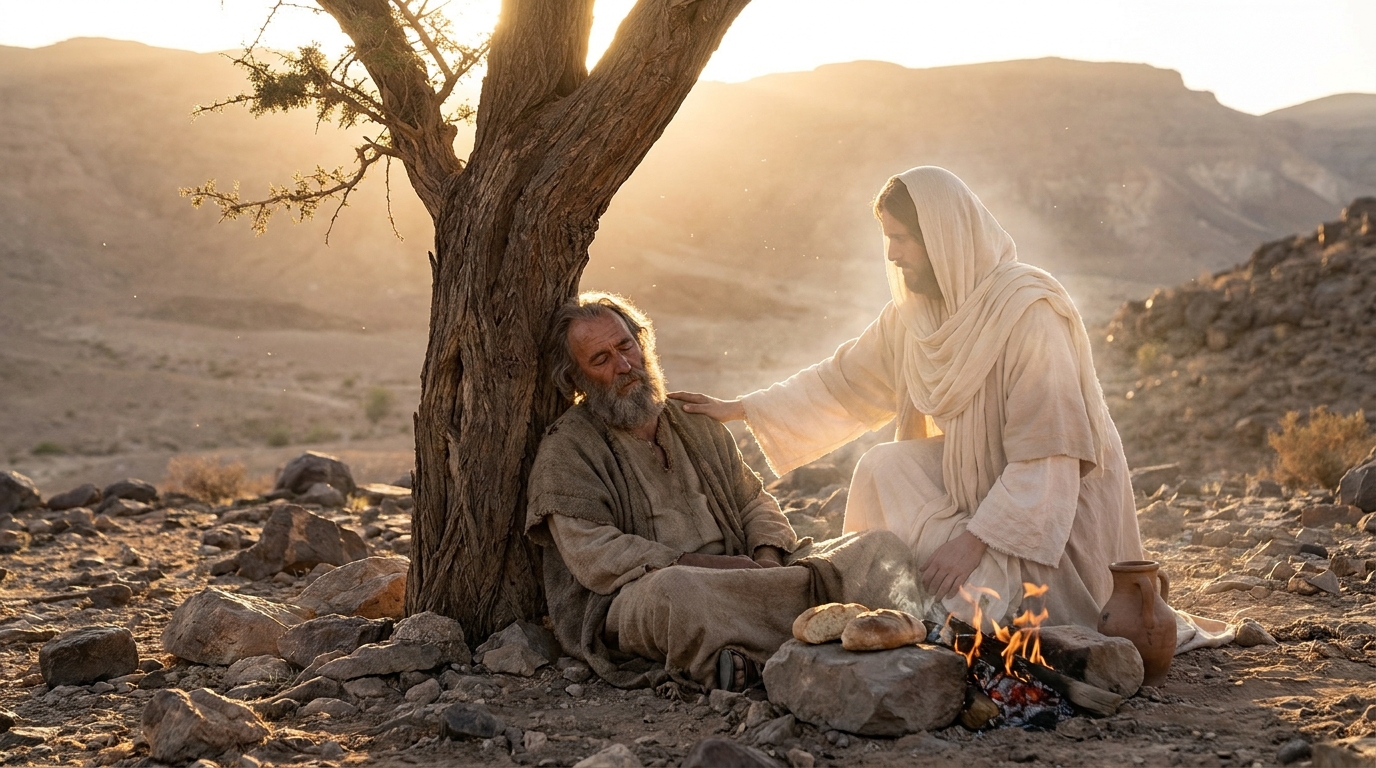
In 1 Kings chapter 19, right on the heels of one of the greatest spiritual victories in the Old Testament, the mighty prophet Elijah hit an emotional wall so severe that he walked a full day’s journey into the desert, collapsed beneath a solitary broom bush, and asked God to take his life. Look at how tenderly the Lord met His exhausted servant—giving us a four-part biblical blueprint for recovering from spiritual and emotional burnout.
📖 Key Biblical Passage: 1 Kings 19:1–18
- 1 Kings 19:1–4: Threatened with execution by Queen Jezebel just hours after Mount Carmel, Elijah flees south to Beersheba, walks a day’s journey into the Negev wilderness, and collapses beneath a broom tree praying to die.
- 1 Kings 19:5–8: Instead of scolding him, an angel of the Lord wakes him twice with fresh bread baked on hot coals and a jar of water, sustaining him for a 40-day trek to Mount Horeb (Sinai).
- 1 Kings 19:9–13: After wind, earthquake, and fire pass the cave, the Lord speaks to Elijah in a gentle, low whisper.
- 1 Kings 19:14–18: God lifts Elijah out of isolation by revealing 7,000 faithful believers left in Israel and providing Elisha to walk beside him as his successor and friend.
4 Comforting Lessons from Elijah Under the Broom Tree
1. Emotional Depletion Often Hits Right After a High-Adrenaline Season
At first glance, the transition between 1 Kings 18 and 1 Kings 19 feels jarring. In chapter 18, Elijah stands fearlessly on Mount Carmel before 850 false prophets, calls down fire from heaven, prays seven times for rain to end a three-and-a-half-year famine, and runs nearly 30 kilometres ahead of Ahab’s chariot all the way to Jezreel! Yet the next morning, a single threatening message from Jezebel sends him running roughly 160 kilometres south to Beersheba in sheer panic (1 Kings 19:2–3).
Why did a fearless prophet suddenly crumble? Because after years of drought survival followed by an intense burst of spiritual, emotional, and physical output, his nervous system was completely empty. Whether you have just finished caring for a sick loved one, navigating a family crisis, or pouring yourself into a demanding season of ministry, remember that the “post-victory crash” is a natural human reality—not a spiritual failure (as James 5:17 reminds us, Elijah was a human being with a nature just like ours!).
2. God’s First Prescription for Burnout Is Sleep, Water, and Warm Bread (1 Kings 19:5–7)
Look closely at what God did when Elijah curled up beneath the desert broom shrub and cried out, “I have had enough, Lord” (1 Kings 19:4). Did God send an angel to preach a stern sermon on perseverance or hand Elijah a longer checklist of chores? Not at all!
Instead, the Lord let Elijah sleep. Then an angel gently touched him, pointed to a warm loaf of bread baking on hot stones and a jar of cool water right by his head, and invited him to eat and drink (1 Kings 19:5–6). And what did Elijah do after eating that meal? He lay right back down and went to sleep again!
God knows that we are embodied souls (Psalm 103:14: “He knows how we are formed; he remembers that we are dust”). Sometimes the holiest thing you can do when your emotions feel fragile is drink a tall glass of water, eat a nourishing meal, and take a restorative nap—practicing the gentle rhythms we explore in cultivating Sabbath rest and peace.
3. The Gentle Whisper: Meeting God Without the Pressure of Noise (1 Kings 19:11–13)
Strengthened by the angel’s provision, Elijah traveled roughly 320 kilometres south across the Sinai peninsula to Mount Horeb—the exact mountain where Moses had met God at the burning bush centuries earlier. There, as Elijah stood at the mouth of a cave, a hurricane-force wind shattered the rocks, followed by an earthquake, followed by a blazing fire—yet Scripture repeats three times that the Lord was not in the wind, the earthquake, or the fire (1 Kings 19:11–12).
Then came what the Hebrew text calls a qol demamah daqqah—literally “a sound of gentle stillness” or a soft, low whisper. On Mount Carmel, Elijah had seen God work through dramatic fire; on Mount Horeb, his bruised heart needed to learn that God is equally present in quiet, unhurried tenderness.
4. Breaking the Lie of Isolation With Community and Shared Burdens (1 Kings 19:14–21)
Twice on that mountain (verses 10 and 14), Elijah repeated the lie that exhaustion always whispers in our ears: “I am the only one left, and now they are trying to kill me too.” Notice how the Lord healed his loneliness with two specific gifts in verses 16–18:
- Perspective: God revealed that Elijah was nowhere near alone—the Lord had quietly preserved 7,000 faithful believers across Israel who had never bowed a knee to Baal.
- ATrusted Friend (Elisha): Before sending Elijah back out, God instructed him to anoint Elisha—not merely to replace him one day, but to walk right beside him, pour water on his hands, and share the daily load so Elijah would never have to walk alone again.
🌿 A Quiet-Time Reflection & Breath Prayer for Today
If your body and spirit feel weary beneath your own “broom tree” today, receive the Lord’s permission to rest without a single ounce of guilt:
- Inhale slowly: “Lord, You remember my frame and meet me with tender care…”
- Exhale in stillness: “…I rest my body and listen for Your gentle whisper of peace.”
Unburden your thoughts onto paper without pressure inside our 30-Day Christian Prayer Journals or our Walking in Grace 52-Week Devotional.
Read the Companion Study: Elijah on Mount Carmel (1 Kings 18) →Frequently Asked Questions About Elijah Under the Broom Tree
What is a “broom tree” in 1 Kings 19:4?
In the arid Negev desert, the white broom bush (Retama raetam, sometimes translated “juniper tree” in older Bibles) is a hardy desert shrub growing 1.5 to 3 metres tall. While its thin branches offer only sparse shade, it is often the only shelter available against the scorching desert sun, and its roots were traditionally burned into glowing charcoal embers to bake flatbread—just like the angel’s coals in verse 6!
Why did God ask Elijah twice, “What are you doing here, Elijah?” (1 Kings 19:9, 13)?
Just as God asked Adam “Where are you?” in Genesis 3:9 and asked Hannah and Hagar to voice their grief, God’s question wasn’t an angry scolding—it was a counselor’s gentle invitation for Elijah to pour out the fear and exhaustion pent up inside his chest so the Lord could speak truth over it.
Which part of God’s care for Elijah in 1 Kings 19—the angel’s warm bread and sleep, the gentle whisper, or the friendship of Elisha—comforts your heart most right now? Share in the comments below!