

Hi friend,
Have you ever felt so stretched thin by your own calendar, family responsibilities, and daily news alerts that when you crossed paths with someone else’s messy crisis, your first instinct was to quietly look the other way?
In a hurried, noisy world, “compassion fatigue” can creep into even the most sincere Christian heart. We tell ourselves that our schedule is too tight, that someone else is surely better equipped to step in, or that we need to keep a safe emotional distance.
In Luke 10:25–37, a religious scholar stood up to test Jesus—and ended up asking a question that every generation tries to use as a loophole: “And who is my neighbor?” (Luke 10:29). By answering him with the unforgettable story of a wounded traveler on the Jericho road (see our companion reflection on The Good Samaritan: A Timeless Call to Compassion), Jesus turned the scholar’s question completely upside down—and showed us how His own mercy empowers us to love without boundaries.
📖 Key Biblical Setting: The Dangerous Road From Jerusalem to Jericho
The Geography of Luke 10:30: The ancient road winding down from Jerusalem (perched roughly 760 metres above sea level) to Jericho (sitting 250 metres below sea level) dropped more than 1,000 metres in elevation across just 27 kilometres of jagged limestone cliffs, blind curves, and desert caves. Known in antiquity as the “Way of Blood” because of frequent bandit ambushes, it was the exact setting every listener in Jesus’s audience knew firsthand.
4 Transformative Lessons on “Who Is My Neighbor?” in Luke 10
1. Why the Priest and the Levite Crossed to the Other Side
In Luke 10:31–32, the first two travelers who spotted the stripped, half-dead man in the ditch were a Jewish priest and a Levite—men whose entire lives were dedicated to serving in the Jerusalem Temple and studying the Scriptures. Yet both men saw him and deliberately crossed to the opposite side of the road.
Why did the most religious people in the story walk past a dying countryman? Under Levitical law (Numbers 19:11), touching a corpse rendered a priest ceremonially unclean for seven days, costing him his turn of Temple duties and temple rations. Because the beaten man looked “half dead,” they chose religious self-preservation and schedule convenience over human mercy. Notice that right after Luke 10:25–37 comes the story of Mary and Martha in Luke 10:38–42—together, the two stories show how Loving God (Mary sitting at Jesus’s feet) and Loving Our Neighbor (the Good Samaritan) always belong hand in hand!
2. Interruptibility Is One of the Clearest Marks of a Grace-Filled Heart
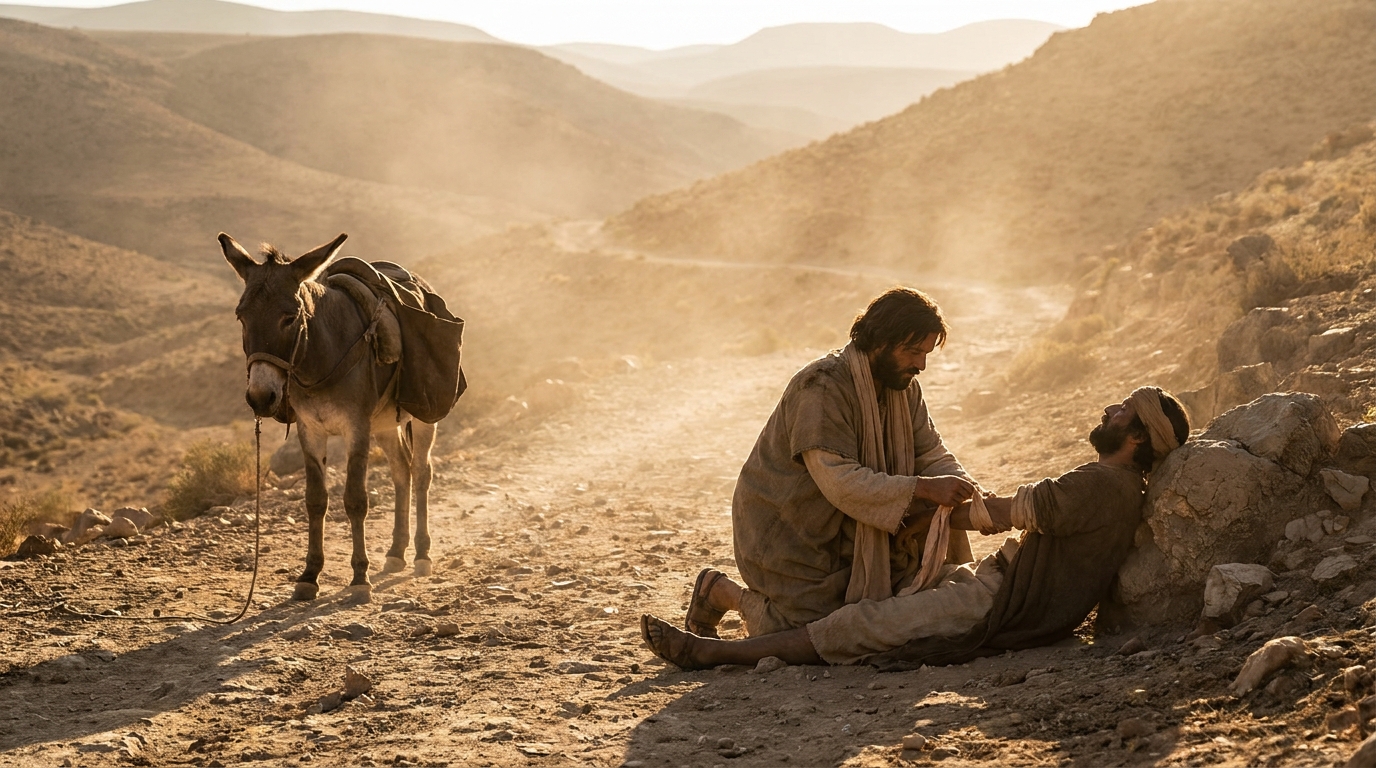
When the Samaritan traveler came down that same rocky pass in Luke 10:33–35, he had his own business schedule, his own donkey loaded with goods, and every reason to hurry past an ambush zone where robbers might still be hiding. Yet when he saw the wounded man, his heart was moved with compassion, and he allowed his plans to be interrupted.
Look at the four tangible ways his internal pity turned into costly action:
- Personal Touch: Instead of shouting encouragement from a distance, he knelt down in the dirt right beside the bleeding man.
- Immediate Care: He tore strips of cloth to bandage the wounds, pouring on his own costly olive oil (to soothe pain) and wine (to cleanse and disinfect).
- Physical Sacrifice: He lifted the injured man onto his own pack animal while walking the remaining steep kilometres on foot himself.
- Generous Provision: He stayed with him through the night at the inn and handed the innkeeper two silver denarii (equal to two full days’ wages, enough for weeks of lodging), promising to cover any extra bill on his return trip.
3. Redefining the Question: From “Who Qualifies?” to “Whose Neighbor Will I Be?”
When the legal expert originally asked, “Who is my neighbor?” in verse 29, he wanted a neat checklist showing where he was allowed to draw the line between “insiders” he had to love and “outsiders” he could ignore. By making a despised Samaritan the hero who rescued a wounded Jew—the same barrier Jesus crossed when speaking with the Samaritan woman at the well—Jesus erased the dividing line completely.
Notice how Jesus flipped the question at the end of the story in Luke 10:36: He didn’t ask, “Which person qualified as a neighbor?” He asked, “Which of these three do you think was a neighbor to the man who fell into the hands of robbers?” Instead of asking who deserves our kindness, Jesus calls us to be a neighbor to anyone God places across our path.
4.Seeing Jesus as Our Ultimate Good Samaritan First
If we read Luke 10 merely as a moral checklist to try harder in our own human energy, we will quickly burn out. How do we find the emotional margin to love hurting people without running dry? By realizing that Jesus Christ is the true Good Samaritan first!
When all of humanity lay wounded, stripped, and helpless in the ditch of sin, religion could only walk past us on the other side of the road. Jesus stepped down into our broken world, poured out the oil and wine of His own precious blood and Holy Spirit to heal our wounds, lifted us up, brought us into the family household of God, and paid our debt in full at the cross. When you rest in how lavishly Jesus has cared for you, His compassion naturally overflows through your hands to others.
🌿 A Quiet-Time Reflection & Breath Prayer for Today
Ask the Lord this morning to give you eyes to notice the one person He places along your road today who needs a kind word, a prayer, or practical help:
- Inhale slowly: “Jesus, You stopped for me and bound up my deepest wounds…”
- Exhale in love: “…fill my heart with Your compassion to be a neighbor today.”
Replenish your spiritual well each morning with our 30-Day Christian Prayer Journals or our Walking in Grace 52-Week Devotional.
Read Next: The Good Samaritan — A Timeless Call to Compassion →Frequently Asked Questions About “Who Is My Neighbor?”
Why wouldn’t the lawyer say the word “Samaritan” in Luke 10:37?
When Jesus asked which of the three men acted as a neighbor, the religious expert couldn’t even bring himself to say “the Samaritan” out loud—instead answering, “The one who had mercy on him” (Luke 10:37)! Even in that small detail, we see how deeply ingrained prejudice gives way when confronted with undeniable mercy.
How much were “two denarii” worth in the Bible?
In the first century, one Roman silver denarius was a full day’s wage for an agricultural worker or soldier. Since a basic room at a roadside inn cost roughly 1/12th to 1/16th of a denarius per day, two denarii covered up to three or four weeks of food and lodging while the wounded traveler recovered.
Has someone ever stepped into your life like a “Good Samaritan” during an unexpected crisis? Share your story of gratitude in the comments below!

