

Hi friend,
Have you ever walked through an unexpected loss that changed the entire trajectory of your life—or prayed faithfully for a promise for so many years that you wondered if your quiet intercession behind closed doors was really making a difference?
Tucked into just three verses of the Christmas and infancy narrative in Luke 2:36–38 is one of the most radiant gems of perseverance in the entire New Testament: the story of Anna the Prophetess.
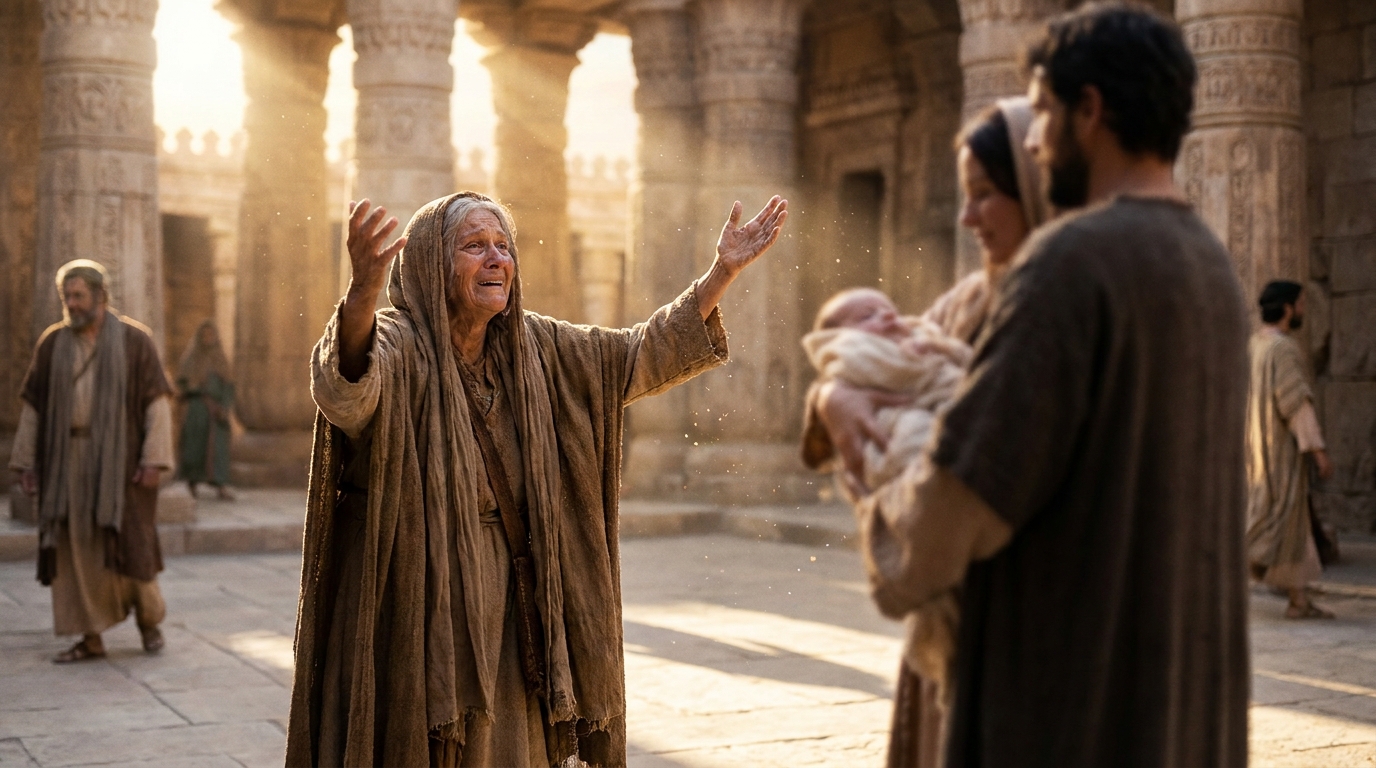
Widowed as a young bride after only seven short years of marriage, Anna could have easily spent the next six decades of her life swallowed up by grief and “what might have been.” Instead, she turned the courts of the Jerusalem Temple into her home—worshipping night and day with fasting and prayer until, in her eighties, she walked up at the exact moment Mary and Joseph carried forty-day-old baby Jesus into the Temple!
📖 Key Biblical Passage: Luke 2:36–38
The Scene in the Temple Courts: Forty days after Jesus’s birth in Bethlehem (see our guide to 7 Astonishing Facts About the Miraculous Birth of Jesus), Mary and Joseph bring the infant Messiah to the Jerusalem Temple to present Him to the Lord with the humble offering of two turtledoves (Luke 2:22–24). While righteous Simeon holds the child and blesses God, elderly Anna the prophetess steps forward to give thanks and proclaim the Redeemer to everyone waiting for Jerusalem’s hope.
4 Transformative Faith Lessons from Anna the Prophetess
1. Turning Early Heartbreak Into Lifelong Intimacy With God (Luke 2:36–37)
Think about the personal grief compressed into a single sentence in Luke 2:36–37: married as a young woman (typically around age thirteen or fourteen in the first century), Anna lost her husband after just seven years of marriage—meaning she became a widow barely out of her teens! Whether she was now eighty-four years old in total, or had been a widow for eighty-four years (which would place her over a hundred years old, as the Greek text allows both readings), Anna had spent more than sixty years walking without her earthly companion.
Unlike Naomi in the Book of Ruth, who initially asked to be called Mara (“bitter”) after losing her husband and sons (see our study on Ruth and Naomi: Cultivating Unwavering Loyalty and Faith), Anna refused to let sorrow make her bitter. Her Hebrew name Hannah (Greek: Anna) means “Grace”—and by anchoring her broken heart in the house of the Lord, she grew sweeter, more prayerful, and more radiant with every passing decade.
2. Quiet Devotion Sharpened Her Eyes to Spot Jesus in a Crowd
Picture how crowded the vast Court of the Women in Herod’s Temple was on an ordinary morning. Hundreds of priests, Levites, wealthy donors, and young couples carrying newborn babies passed through those gates every day. To the naked eye, Mary and Joseph looked like any other poor Galilean couple carrying the smallest purification offering allowed by the Law (two pigeons rather than a lamb).
Why did the religious elite walk right past Mary and Joseph without a second glance, while Simeon and Anna recognized the King of Glory immediately? Because decades of cultivating a persistent daily prayer habit and fasting had tuned Anna’s spiritual ears to the whisper of the Holy Spirit! When you spend time with God in secret every day, you recognize His hand moving in ordinary moments that everyone else misses.
3. Why Luke Mentions Her “Lost” Tribe of Asher (Luke 2:36)
Have you ever wondered why Luke carefully records Anna’s genealogy in Luke 2:36—identifying her as the daughter of Phanuel, of the tribe of Asher? Seven hundred years earlier, when the northern kingdom of Israel was conquered by Assyria, the ten northern tribes (including Asher) were scattered abroad and often written off as “the ten lost tribes.”
Yet God never lost track of a single tribe or a single daughter! In Jacob’s ancient prophetic blessing over his sons in Genesis 49:20 and Moses’s blessing in Deuteronomy 33:24, the tribe of Asher (meaning “Happy / Blessed”) was promised rich royal delicacies and strength that would last as long as their days. Standing in the Temple at age eighty-four, Anna was the living fulfillment of that promise—beholding the true Bread of Heaven with her own eyes.
4. You Never “Age Out” of Your Most Important Kingdom Calling (Luke 2:38)
Notice what 84-year-old Anna did the instant she saw baby Jesus in Luke 2:38: first, she gave thanks to God, and second, “she spoke about the child to all who were looking forward to the redemption of Jerusalem.”
After sixty years of quiet, unseen intercession inside the Temple courts, Anna stepped into her greatest missionary assignment in her eighties—becoming the very first female evangelist to proclaim Jesus inside the city of Jerusalem! Whether you are in your thirties, fifties, or eighties, never believe the lie that your most fruitful spiritual seasons are behind you.
🌿 A Quiet-Time Reflection & Breath Prayer for Today
If you have been praying faithfully over a family member, a promise, or a quiet calling for years, take heart from Anna—not a single hour of your intercession is ever wasted:
- Inhale slowly: “Lord, I bring my waiting heart into Your courts today…”
- Exhale in hope: “…open my eyes to recognize Your redemption and give You thanks.”
Keep a lasting treasury of your prayers and praises inside our printable 30-Day Christian Prayer Journals or our Walking in Grace 52-Week Devotional.
Read Next: Hannah’s Prayer — Finding Peace in Seasons of Waiting →Frequently Asked Questions About Anna the Prophetess
Why did Luke pair Simeon (a man) and Anna (a woman) together in Luke 2:25–38?
Throughout the Gospel of Luke, the Holy Spirit frequently pairs a man and a woman side by side as twin witnesses of God’s grace (such as Zechariah and Elizabeth in Luke 1, or the centurion and the widow of Nain in Luke 7). Under Deuteronomy 19:15, every matter was established by the testimony of two or three witnesses—and God chose one devout man (Simeon) and one devout woman (Anna) to officially welcome His Son at the Temple!
Did Anna literally sleep inside the Temple building (“she never left the temple”)?
While only priests entered the inner sanctuary, the outer Temple complex covered roughly 14 hectares (35 acres) of colonnaded porches and courts open from sunrise to sunset. Saying she “never departed from the temple” (Luke 2:37) either meant she was present at every single morning and evening sacrifice from dawn till dusk without fail, or that as an honored elderly prophetess and widow, she was granted a small lodging chamber along the outer Temple precincts.
What inspires you most about Anna’s sixty years of faithful prayer and joyful witness in Luke 2? Share your thoughts in the comments below!

