

Hi friend,
Have you ever looked at your daily routine—the ordinary skills, household tasks, and simple resources sitting right in front of you—and felt like you weren’t “equipped” enough to make a real spiritual impact?
We often picture spiritual warriors wearing gleaming armor on a grand stage. Yet throughout the Book of Judges, God repeatedly bypassed conventional military power to win victories through the most unexpected people holding the most ordinary everyday tools.
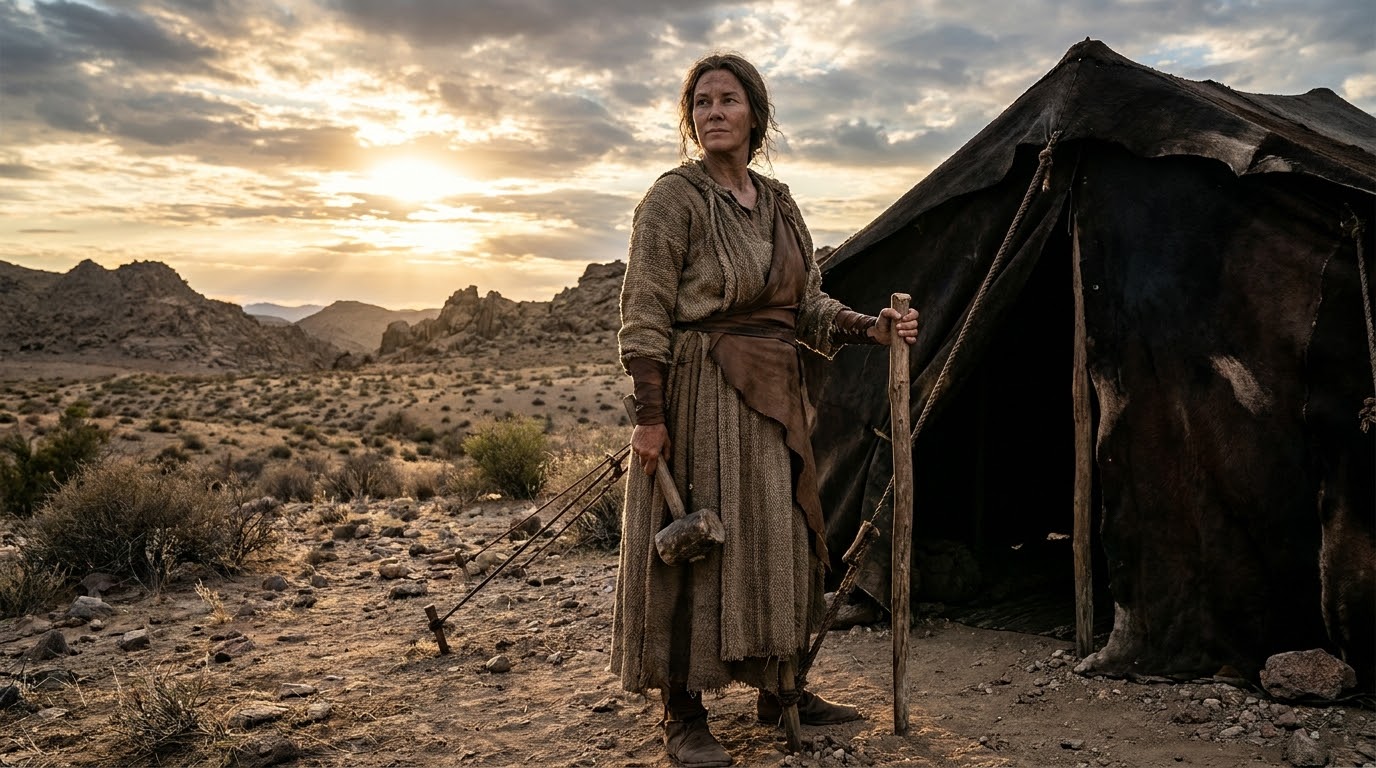
In Judges chapters 4 and 5, right alongside the towering leadership of Deborah the prophetess and judge, Scripture spotlights a nomadic woman named Jael, the wife of Heber the Kenite. Never trained for battle and living quietly in a goat-hair tent near Kedesh, Jael stepped into a sudden moment of crisis and used the simple household tools in her hands to end twenty years of Canaanite oppression—earning the title in Judges 5:24: “Most blessed of women be Jael… most blessed of tent-dwelling women.”
📖 Key Biblical Passages on Jael (Judges 4–5)
- Judges 4:9 & 4:11: Deborah prophesies to Barak that the Lord will deliver General Sisera into the hand of a woman; meanwhile, Heber the Kenite pitches his tent near the great tree in Zaanannim.
- Judges 4:15–20: After God routs Sisera’s 900 iron chariots at the Kishon River, Sisera abandons his chariot and flees on foot to Jael’s tent, assuming he is safe because of her husband’s alliance with King Jabin.
- Judges 4:21–22 & 5:24–27: Using warm curdled milk, a covering rug, a wooden tent peg, and a workman’s mallet, Jael defeats Israel’s oppressor and is celebrated in the Song of Deborah.
4 Transformative Faith Lessons from Jael in the Bible
1. Choosing Loyalty to God Even When Those Around You Compromise (Judges 4:11, 17)
To understand why General Sisera ran straight to Jael’s tent when his army collapsed, look at the background note in Judges 4:11 and 4:17: Jael’s husband, Heber the Kenite, had separated from his fellow Kenites (who were loyal descendants of Moses’s father-in-law Jethro) and had struck a political peace treaty with Jabin, the cruel Canaanite king oppressing Israel!
When Sisera arrived exhausted at her tent door, Jael faced an immediate choice: go along with her household’s comfortable political compromise with the enemy, or take a stand alongside the covenant people of the Living God. Like Rahab in Jericho, Jael chose to align her heart with the God of Israel rather than bowing to a tyrant.
2. God Uses the Everyday Tools Already in Your Hands (Judges 4:21)
In nomadic Bedouin and Kenite culture, who was responsible for pitching, taking down, and anchoring the heavy woven tents every time the camp moved? The women!
For years, every time Jael swung a heavy wooden mallet to drive oak tent pegs into the hard rocky soil of northern Israel, it probably felt like repetitive, mundane housework. She had no idea that decades of pitching tents had given her the exact grip, aim, and strength she would need in a single decisive hour to deliver God’s people! Just as God asked Moses at the burning bush what was in his hand (a simple shepherd’s staff) and used David’s shepherd sling against Goliath, God never requires weapons you haven’t practiced with—He uses the everyday skills right inside your “tent.”
3. Calm Wisdom Over Panic When the Enemy Approaches Your Door
When a ruthless military commander showed up uninvited at her tent flap in Judges 4:18–19, Jael didn’t panic. Notice her calm, strategic composure: when Sisera asked for a drink of water, Judges 4:19 and 5:25 note that she opened a skin of rich, fermented goat’s milk (curds/buttermilk) and served it in a lordly bowl—knowing that a heavy, warm dairy meal would quickly lull an exhausted fugitive into a deep sleep!
In our spiritual walk, putting on the Armor of God for women and the helmet of salvation means we don’t have to react in frantic fear when spiritual battles try to push their way into our homes. We can stand our ground with clear-minded, prayerful authority.
4. God’s Prophecies Are Often Fulfilled Through Two Women Working in Different Places
Think about how beautifully **Deborah** and **Jael** complement each other across Judges chapters 4 and 5:
- Deborah served in public national leadership beneath the palm tree and on Mount Tabor, speaking God’s prophetic word in Judges 4:9.
- Jael lived miles away in a quiet tent—likely having no idea what Deborah had prophesied that morning—yet her faithful action fulfilled Deborah’s word to the letter!
Whether God has placed you on a public “Mount Tabor” like Deborah or inside a quiet “tent” at home like Jael, both callings are equally vital in God’s redemptive plan—and both are celebrated side by side in the song of heaven (Judges 5:7, 24).
🌿 A Quiet-Time Reflection & Breath Prayer for Today
Never look down on the ordinary, repetitive work inside your “tent” today—God is using every faithful habit to build spiritual strength in your hands:
- Inhale slowly: “Lord, I place the ordinary tools and tasks of my home into Your hands…”
- Exhale in courage: “…give me wisdom and boldness to guard the peace of my household.”
Strengthen your daily spiritual walk with our printable 30-Day Christian Prayer Journals or our Walking in Grace 52-Week Devotional.
Read Next: Deborah in the Bible — Leading with Quiet Strength →Frequently Asked Questions About Jael in the Bible
What does the name Jael mean in Hebrew?
In Hebrew, the name Jael (Ya’el) means “mountain goat” or “wild ibex”—an agile, sure-footed animal famous in the rocky cliffs of Israel for climbing heights where predators could not follow.
Who were the Kenites in Judges 4:11?
The Kenites were a clan of nomadic metalworkers and tent-dwellers descended from Hobab/Jethro, the Midianite father-in-law of Moses (Judges 1:16; 4:11). Because they had shown kindness to Israel during the wilderness journey out of Egypt, they lived peacefully among the tribes of Israel for centuries (1 Samuel 15:6).
How does seeing God use Jael’s everyday “tent-pitching” skills encourage you in your own daily responsibilities? Share your thoughts in the comments below!

