Hi friend,
Have you ever felt outnumbered when trying to stand for your Christian faith in a culture—or even a family or workplace—that pulls in the exact opposite direction?
When our faith feels pulled between trusting God wholeheartedly and blending in with the crowd around us, we lose our spiritual peace. Divided loyalty is exhausting to the human soul.
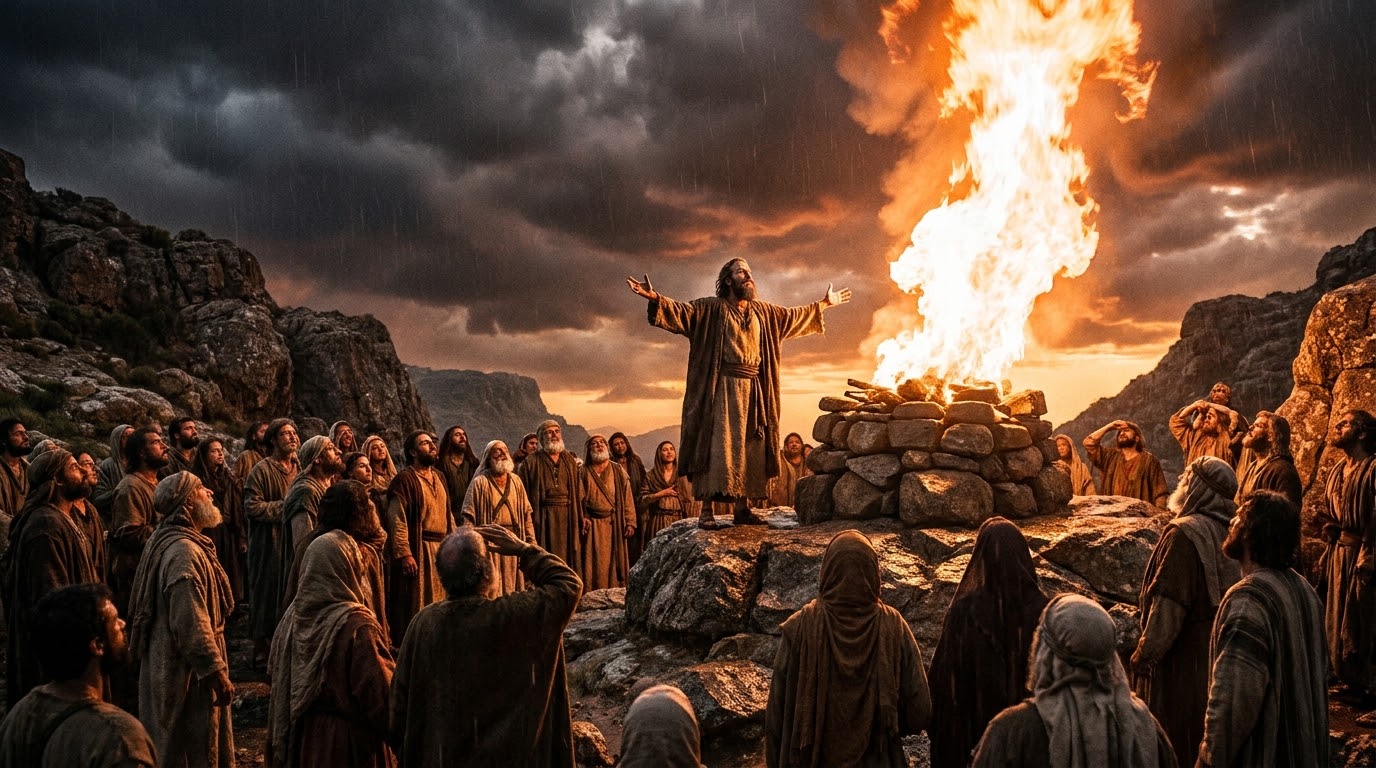
In 1 Kings chapter 18, after three and a half years of severe drought across the northern kingdom of Israel, the prophet Elijah (whose Hebrew name Eliyahu literally means “My God is the Lord”) summoned King Ahab, 450 prophets of Baal, 400 prophets of Asherah, and the wavering people of Israel to the high ridge of Mount Carmel. What unfolded that afternoon—both in the fire that fell at the evening sacrifice and the raincloud the size of a man’s hand that followed—gives us four timeless lessons on wholehearted devotion and persistent prayer.
📖 Key Biblical Passage: 1 Kings 18:17–46
- 1 Kings 18:20–24: Standing on Mount Carmel (rising roughly 525 metres above the Mediterranean coast and the Jezreel Valley), Elijah challenges Israel to stop wavering between two opinions and proposes the test of fire.
- 1 Kings 18:25–29: From morning until mid-afternoon, the 450 prophets of Baal shout and dance around their altar, but there is no voice and no one answers.
- 1 Kings 18:30–39: Elijah repairs the broken altar of the Lord with 12 stones, drenches the sacrifice three times with four large jars of water, and prays a short, calm prayer—and the fire of the Lord falls immediately.
- 1 Kings 18:41–46: Bowing in intercession seven times until a tiny cloud appears over the sea, Elijah witnesses the torrential rain that ends the famine.
4 Transformative Faith Lessons from Elijah on Mount Carmel
1. Healing a Divided Heart: “How Long Will You Limp Between Two Opinions?” (1 Kings 18:21)
Before addressing the pagan prophets, Elijah turned straight to the people of Israel and asked the piercing question of 1 Kings 18:21: how long would they waver (literally in Hebrew, “limp or hop back and forth like a bird on two branches”) between two opinions? If the Lord is God, follow Him!Notice that the Israelites hadn’t officially rejected Yahweh—they were simply trying to worship the Lord on the Sabbath while also keeping Baal (the Canaanite storm and fertility idol) on the side for economic security.
Like Shadrach, Meshach, and Abednego refusing to bow in Babylon, spiritual breakthrough begins the moment we stop straddling the fence and surrender our whole heart to the Lord.
2. Before the Fire Falls, Repair the Broken Altar First (1 Kings 18:30–32)
Look at the very first physical action Elijah took when his turn arrived at the time of the afternoon sacrifice (around 3:00 PM) in 1 Kings 18:30: he invited all the people to come close to him, and he repaired the altar of the Lord, which had been torn down.
Even though the nation had split into two rival kingdoms decades earlier, Elijah deliberately selected twelve stones—one for each of the twelve tribes of Jacob (verse 31)—reminding the people of their true covenant identity. In our own lives, whenever our spiritual passion feels cold, the first step is never frantic busyness; it is quietly rebuilding the daily altar of personal prayer and time in God’s Word (just as Gideon rebuilt the altar in his father’s yard in Judges 6).
3. Drenching the Altar With Water: Why God Loves Impossible Odds (1 Kings 18:33–39)
After digging a trench around the stone altar, Elijah gave an instruction that must have stunned a drought-stricken crowd: fill four large clay jars with water (likely drawn from the perennial springs along the slopes of Carmel or the Mediterranean Sea below) and pour it right over the offering and the firewood—and then do it a second and third time until twelve jars of water soaked the wood and filled the trench (1 Kings 18:33–35)!
Why soak firewood right before praying for fire? So that no skeptic watching could ever claim a hidden spark had been smoldering beneath the logs! Then, in stark contrast to the six hours of frantic shouting by Baal’s prophets, Elijah stepped forward and prayed a calm, two-sentence prayer in verses 36–37—asking the Lord to answer so the people would know He was turning their hearts back again. Immediately, the fire of the Lord fell, consuming the sacrifice, the wet wood, the stones, the soil, and every drop of water in the trench—bringing the entire multitude to their faces in worship.
4. Praying Seven Times for the Cloud the Size of a Man’s Hand (1 Kings 18:41–45)
Notice the difference between Elijah’s two prayers on Mount Carmel that day. For the fire, he only had to pray once; for the rain to end the drought, he climbed to the top of Carmel, bowed down with his face between his knees in humble intercession, and sent his servant to scan the western horizon toward the Mediterranean Sea seven consecutive times (1 Kings 18:42–43).
Six times in a row, the servant came back and reported: “There is nothing there.” Did Elijah give up after the third or sixth check? No—because God had already promised rain in 1 Kings 18:1, Elijah kept praying until, on the seventh look, a tiny cloud no bigger than a man’s hand rose from the sea, quickly blanketing the sky with life-giving rain! When you are practicing persistent daily prayer over your family, never stop praying on the sixth check when the seventh is just ahead—and remember to rest afterward, as we see in our companion study on Elijah Under the Broom Tree in 1 Kings 19.
🌿 A Quiet-Time Reflection & Breath Prayer for Today
Even if the answer to your prayer currently looks no bigger than a tiny cloud on the horizon, keep trusting the God who answers by fire and sends the rain:
- Inhale slowly: “Lord, I repair the daily altar of my heart before You…”
- Exhale in expectant faith: “…turn our hearts back to You and send Your refreshing rain.”
Rebuild a peaceful, unhurried daily prayer rhythm with our 30-Day Christian Prayer Journals or our Walking in Grace 52-Week Devotional.
Read Part 2 Next: Elijah Under the Broom Tree (1 Kings 19) →Frequently Asked Questions About Elijah on Mount Carmel
Why did Elijah choose Mount Carmel for the contest against Baal?
In Canaanite mythology, Baal was worshipped as the god of thunder, lightning, and rain, and lush Mount Carmel was considered Baal’s sacred mountain stronghold. By challenging Baal’s prophets to call down fire (lightning) on Baal’s own home turf—and watching Baal remain completely silent—God exposed the total powerlessness of the idol before the entire nation.
Where did Elijah get twelve jars of water during a severe drought?
Mount Carmel sits right along the coast of the Mediterranean Sea and features perennial underground limestone springs (such as the spring near the traditional site of El-Muhraqa) that continue to trickle even when surface rivers dry up, providing more than enough water to fill the four large jars three times.
Are you currently in a season of “repairing your daily altar” or “looking for the seventh-time raincloud” in prayer? Share how we can pray with you in the comments below!