Hi friend,
Have you ever looked back on a chapter of your life where you chased the wrong priorities, compromised your values for security, or drifted far from God—and wondered how the Lord could ever use someone with your track record in His kingdom?
In first-century Galilee, no citizen stood lower on the religious and moral ladder than a tax collector. Stationed at toll booths along the busy trade highways and fishing harbors of Capernaum, Jewish publicans leased tax-collection rights from the occupying Roman Empire and made their personal living by adding steep surcharges onto their own neighbors’ goods. Barred from serving as witnesses in Jewish courts and shunned in the synagogues as traitors, they were treated as irredeemable outcasts.
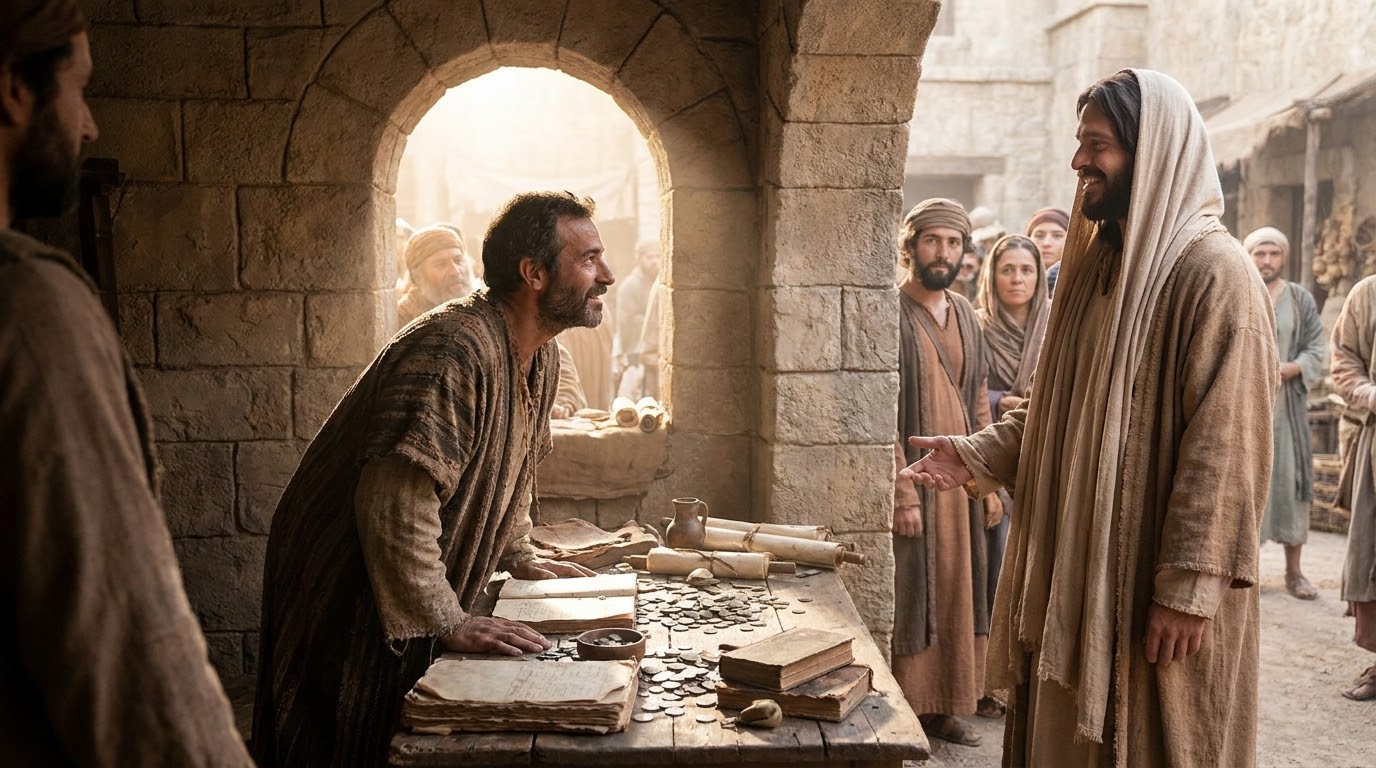
Yet when Jesus walked past a customs booth along the shore in Matthew 9:9–13 (and parallel accounts in Mark 2:13–17 and Luke 5:27–32), He stopped in front of a tax official named Matthew (also called Levi) and extended a two-word invitation that changed church history forever. Featured in our pillar guide to the 12 Disciples’ Strengths and Weaknesses, Matthew’s transformation proves that Jesus never consults your past to decide your future.
📖 Key Biblical Passages on the Life of Matthew (Levi)
- Matthew 9:9 & Mark 2:14: Sitting at his customs post in Capernaum, Matthew hears Jesus call him to follow and immediately leaves everything behind.
- Luke 5:29–32: Matthew hosts a large banquet in his home so his fellow tax collectors and outcast friends can sit at the table with Jesus.
- Matthew 10:3 & Acts 1:13: Humbly referring to himself as “Matthew the tax collector” in the apostolic roster, he serves faithfully alongside the Twelve and authors the first Gospel of the New Testament.
The Strengths and Weaknesses of Matthew the Apostle
When we examine the Gospel portraits of Levi, we see both the painful compromises of his former life and the extraordinary strengths that bloomed once grace captured his heart:
- Strength — Immediate, Burn-the-Ships Obedience (Luke 5:28): When fishermen like Simon Peter and Andrew left their nets to follow Jesus, they could always return to their family boats if things didn’t work out. Once Matthew stood up and walked away from a Roman customs booth, dozens of eager bidders were waiting to take his post—meaning there was zero going back.
- Strength — Contagious Hospitality (Luke 5:29): Matthew’s first instinct as a new believer wasn’t to hide his old friends in embarrassment; he opened his dining room and threw a feast so every other outcast in Capernaum could meet the Healer of his soul.
- Strength — Meticulous Record-Keeping and Scripture Mastery: Unlike many working-class Galileans, a customs official had to be fluent in Aramaic and Greek, skilled in shorthand writing, and precise with records. God redeemed those exact bookkeeping skills to pen the Gospel of Matthew!
- Weakness — A Past Rooted in Materialism and Compromise: Before meeting Christ, Matthew had traded his spiritual heritage and community trust for financial gain—similar to Jericho’s chief collector in our study of Zacchaeus climbing the sycamore tree.
- Weakness — Lingering Memories of Shame: Notice that while Mark and Luke politely list him simply as “Matthew” in their lists of the Twelve (Mark 3:18; Luke 6:15), in his own Gospel (Matthew 10:3) he includes the humbling label “Matthew the tax collector”—never forgetting the depth of the pit from which grace had rescued him.
4 Transformative Faith Lessons from the Story of Matthew
1. Jesus Sees a “Gift of God” Where the World Sees a Lost Cause
In Mark 2:14 and Luke 5:27, we learn that Matthew’s original Hebrew name was Levi (son of Alphaeus)—a name traditionally associated with the priestly tribe of Israel, making his career working for pagan Rome even more painful to his family. Yet after answering Jesus’s call, he became universally known as Matthew (from the Hebrew Mattityahu, meaning “Gift of the Lord”).
Every pious citizen walking past that Capernaum toll booth saw a traitor to cross the street and avoid. Jesus looked at the exact same booth and saw a precious gift of God waiting to be redeemed. As we explore in our reflection on whether any past mistake is too big for God’s forgiveness, Christ never defines you by the booth you used to sit in.
2. God Doesn’t Waste Your Natural Skills—He Sanctifies Them
Think about what Matthew held in his hand all day at the customs table: a stylus pen and a ledger scroll used to tally tariffs on fish, textiles, and spice caravans passing along the Via Maris trade route. When Matthew stood up to follow Jesus, he left his coins and his tax tables behind—but he brought his pen with him.
Under the inspiration of the Holy Spirit, that former tax collector’s pen went on to write the 28 chapters of the Gospel of Matthew—quoting or referencing the Old Testament Scriptures over sixty times to prove that Jesus of Nazareth is the promised Messiah! Whatever administrative, creative, or practical skills you have developed in secular seasons of life, God can repurpose them for eternal impact.
3. The Great Physician Came Specifically for the Hurting (Matthew 9:12–13)
When the Pharisees saw Jesus reclining at Matthew’s banquet table surrounded by tax collectors and social outcasts, they grumbled to His disciples about the company He kept (Matthew 9:11). Overhearing their critique, Jesus replied with a vivid medical truth: healthy people do not seek out a physician, only those who know they are sick—and He had come to call sinners, not the self-righteous, declaring that God desires mercy rather than empty ritual sacrifice (quoting Hosea 6:6).
Admitting our brokenness is never a barrier to Jesus; it is the sole qualification required to receive His healing touch.
4. Gratitude Turns Your Living Room Into a Mission Field
Matthew knew his former colleagues would never feel welcome stepping inside a local synagogue—so he brought the synagogue’s Messiah into his own dining room! You don’t have to preach from a pulpit to share the Gospel; sometimes the most powerful evangelism on earth is simply opening your kitchen table, brewing a pot of coffee, and welcoming hurting neighbors into the warmth of Christ’s love.
🌿 A Quiet-Time Reflection & Breath Prayer for Today
Whatever old “tax booth” of regret, fear, or worldly security Jesus is inviting you to walk away from today, hear His gentle voice calling you forward:
- Inhale slowly: “Jesus, You are the Great Physician who met me in my need…”
- Exhale in freedom: “…I leave my past behind and follow You with a grateful heart.”
Record your daily walk with the Savior inside our printable 30-Day Christian Prayer Journals or our Walking in Grace 52-Week Devotional.
Explore Next: All 12 Disciples’ Strengths and Weaknesses →Frequently Asked Questions About Matthew in the Bible
Why did Jesus put both Matthew the tax collector and Simon the Zealot on the same team?
In human politics, Matthew (who worked for the Roman government) and Simon the Zealot (who belonged to a fierce anti-Roman nationalist movement) would have been bitter enemies! By placing both men side by side among the 12 Disciples of Jesus, Christ demonstrated that His kingdom unites people across the deepest political and social divides.
Where did Matthew minister after the Resurrection?
According to early church historians, Matthew preached the Gospel for roughly fifteen years among Jewish communities in Judea before traveling abroad to proclaim Christ in Ethiopia and Persia.
How has God taken a skill or experience from your past and used it for His glory? Share your encouragement in the comments below!