Hi friend,
Are you the kind of person who instinctively pulls out a mental calculator whenever a problem arises—measuring the budget, the logistics, and the obstacles before taking a step? Or have you ever caught yourself feeling a wave of quiet skepticism when someone shares a testimony that sounds almost too good to be true?
Across the four lists of the 12 Disciples of Jesus in the New Testament, two close friends are always paired side by side: Philip (from Bethsaida) and Nathanael (from Cana of Galilee, also known by his family surname Bartholomew). Together, they represent two deeply relatable personalities: the practical, numbers-minded planner and the candid, no-nonsense skeptic.
Beginning with their unforgettable first conversation in John 1:43–51, their journey with Christ shows us how God meets both our logical spreadsheets and our honest doubts with grace.
📖 Key Biblical Passages on Philip and Nathanael
- John 1:43–46: Called directly by Jesus in Galilee, Philip rushes to tell his friend Nathanael—answering Nathanael’s skepticism about Nazareth with three simple words: “Come and see.”
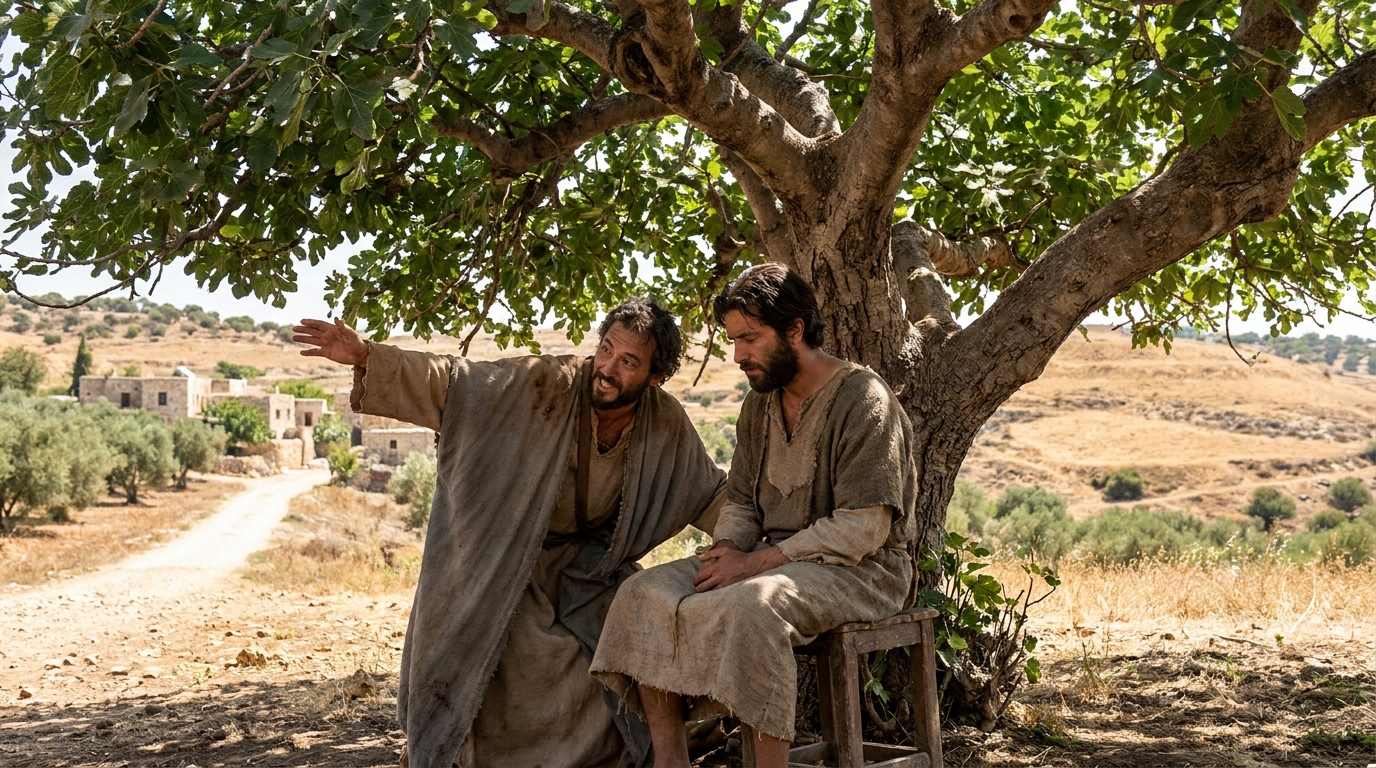
- John 1:47–51: Jesus commends Nathanael’s guileless integrity and reveals that He saw him praying privately beneath a fig tree before Philip ever called him.
- John 6:5–7: Testing Philip’s faith on the hillside, Jesus asks where to buy bread for the crowd, and Philip calculates that two hundred denarii wouldn’t buy enough for each person to have a bite.
- John 14:8–9: In the Upper Room, Philip asks Jesus to show them the Father, prompting Jesus’s tender reminder that whoever has seen Him has seen the Father.
Comparing the Strengths and Weaknesses of Philip & Nathanael
As we highlight in our pillar study on the 12 Disciples’ Strengths and Weaknesses, both men brought genuine gifts—and blind spots—into their walk with Jesus:
- Philip’s Strengths: He was an eager student of the Old Testament Law and Prophets (John 1:45), an organized administrator who seemed to manage food and travel logistics for the group, and a warm friend eager to share the Messiah.
- Philip’s Weaknesses: Because he was wired to look at visible numbers and budgets first, he struggled to factor Jesus’s supernatural power into the equation (John 6:7) and was sometimes slow to grasp the deeper spiritual reality standing right in front of him (John 14:8–9).
- Nathanael’s Strengths: He possessed rare inward honesty and devotion—meditating on the Scriptures beneath the shade of his fig tree and receiving the highest personal compliment Jesus ever paid a newcomer: an Israelite in whom there was zero deceit or hypocrisy (John 1:47).
- Nathanael’s Weaknesses: He initially allowed local small-town prejudice (“Can anything good come from Nazareth?” in John 1:46) to make him dismissive before examining the facts for himself.
4 Transformative Lessons from Philip and Nathanael
1. “Come and See” Is More Powerful Than Winning an Argument (John 1:46)
When Philip enthusiastically told Nathanael that they had found the Messiah spoken of by Moses and the prophets—Jesus of Nazareth—Nathanael balked at the hometown name. Situated just 6 kilometres south of Nathanael’s hometown of Cana across the hills of Lower Galilee, tiny Nazareth was an unglamorous agricultural village that wasn’t even mentioned directly by name in the Old Testament.
Notice how Philip responded in John 1:46: he didn’t get defensive, launch into a heated debate, or feel pressured to have every theological answer on the tip of his tongue. He simply smiled and said, “Come and see.” Whenever you feel nervous about sharing your faith with a skeptical friend or family member, remember that you don’t have to argue anyone into the kingdom—simply invite them to experience the grace of Jesus firsthand!
2. Under the Fig Tree: God Sees Your Secret Prayers When No One Else Is Looking
What melted Nathanael’s skepticism in less than sixty seconds? As Nathanael walked up in John 1:47–48, Jesus remarked that he was a man of complete honesty—and when a surprised Nathanael asked how Jesus knew him, the Lord replied that He had seen him while he was still sitting under the fig tree before Philip ever called him!
In first-century Galilee, the broad, leafy canopy of a courtyard fig tree served as a private outdoor prayer closet where devout believers went to read the Scriptures and pour out their hearts to God alone. Evidently, Nathanael had just been under that fig tree pouring out a private prayer or longing for the Messiah that no human ear had heard. In an instant, Nathanael realized that the Man standing before him was the omniscient Son of God and King of Israel (John 1:49). Just like Hannah pouring out her silent prayer at Shiloh, every tear and whisper you offer in your quiet time is seen intimately by Jesus.
3. Don’t Let Your Mental Spreadsheet Crowd Out the Miracle-Worker (John 6:5–7)
Months later, when a multitude of five thousand men (plus women and children) gathered on the mountainside near Bethsaida, Jesus turned specifically to Philip and asked where they could buy bread to feed everyone. John 6:6 gives us a delightful parenthetical note: Jesus asked this only to test Philip, because He already knew what He was going to do!
Philip immediately ran the numbers in his head and concluded that even two hundred silver denarii (roughly eight months of wages!) wouldn’t buy enough bread for each person to get a single bite. Philip calculated the size of the crowd and the emptiness of their purse—but he forgot to count the Creator of heaven and earth standing right beside him! Being a wise steward is good, but never let human math convince you that a problem is too big for God.
4. To See Jesus Is to See the Heart of the Father (John 14:8–9)
On the night before the cross, right after Thomas asked how to know the way in John 14:5, Philip voiced a deep human longing in verse 8—asking Jesus to show them a visible manifestation of God the Father, and declaring that would be enough for them.
Listen to the tender patience in Jesus’s reply in John 14:9: having walked with Philip for three years, how could Philip still not realize that anyone who has seen Jesus has seen the Father? Whenever you wonder what God the Father feels toward you when you are tired, hurting, or afraid, you never have to guess—just look at the compassion of Jesus in the Gospels, and you are looking straight into the Father’s heart.
🌿 A Quiet-Time Reflection & Breath Prayer for Today
Whether your mind has been racing with Philip-like calculations over a practical need or wrestling with Nathanael-like questions, rest beneath the “fig tree” of Jesus’s gaze today:
- Inhale slowly: “Jesus, You saw me in secret before I ever called out to You…”
- Exhale in trust: “…I lay down my anxious calculations and trust Your provision.”
Meet with the Lord in your own daily “fig tree” sanctuary using our 30-Day Christian Prayer Journals or our Walking in Grace 52-Week Devotional.
Explore Next: All 12 Disciples’ Strengths and Weaknesses →Frequently Asked Questions About Philip and Nathanael
Are Nathanael and Bartholomew the same disciple in the Bible?
Yes! In the Synoptic Gospels (Matthew, Mark, and Luke), Philip is always paired with Bartholomew, whereas in John’s Gospel, Philip is paired with Nathanael. Because Bar-Talmai (Bartholomew) is an Aramaic surname meaning “Son of Tolmai,” biblical scholars agree that his full name was Nathanael Bar-Talmai (Nathanael, son of Tolmai).
Was Philip the Apostle the same person as Philip the Evangelist in Acts 8?
No—the New Testament features two faithful men named Philip: Philip the Apostle (one of the original Twelve from Bethsaida, featured in John’s Gospel) and Philip the Evangelist/Deacon (one of the seven Greek-speaking leaders chosen in Acts 6:5 to care for widows, who later shared the Gospel with the Ethiopian official in Acts 8).
Do you relate more to Philip’s analytical spreadsheets or Nathanael’s candid honesty under the fig tree? Share your thoughts in the comments below!