

Hi friend,
Have you ever stepped out in faith to rebuild something broken in your life—restoring a family relationship, establishing a healthy spiritual rhythm, recovering after burnout, or launching a God-given project—only to get hit by a wave of criticism, exhaustion, and unexpected distractions right in the middle of the work?
Starting a new season of obedience is often exciting, but it is in the dusty, unglamorous middle of rebuilding where our resolve gets tested. When progress feels slow and the piles of rubble look taller than the progress we have made, discouragement whispers that it would be much easier to put down our tools and walk away.
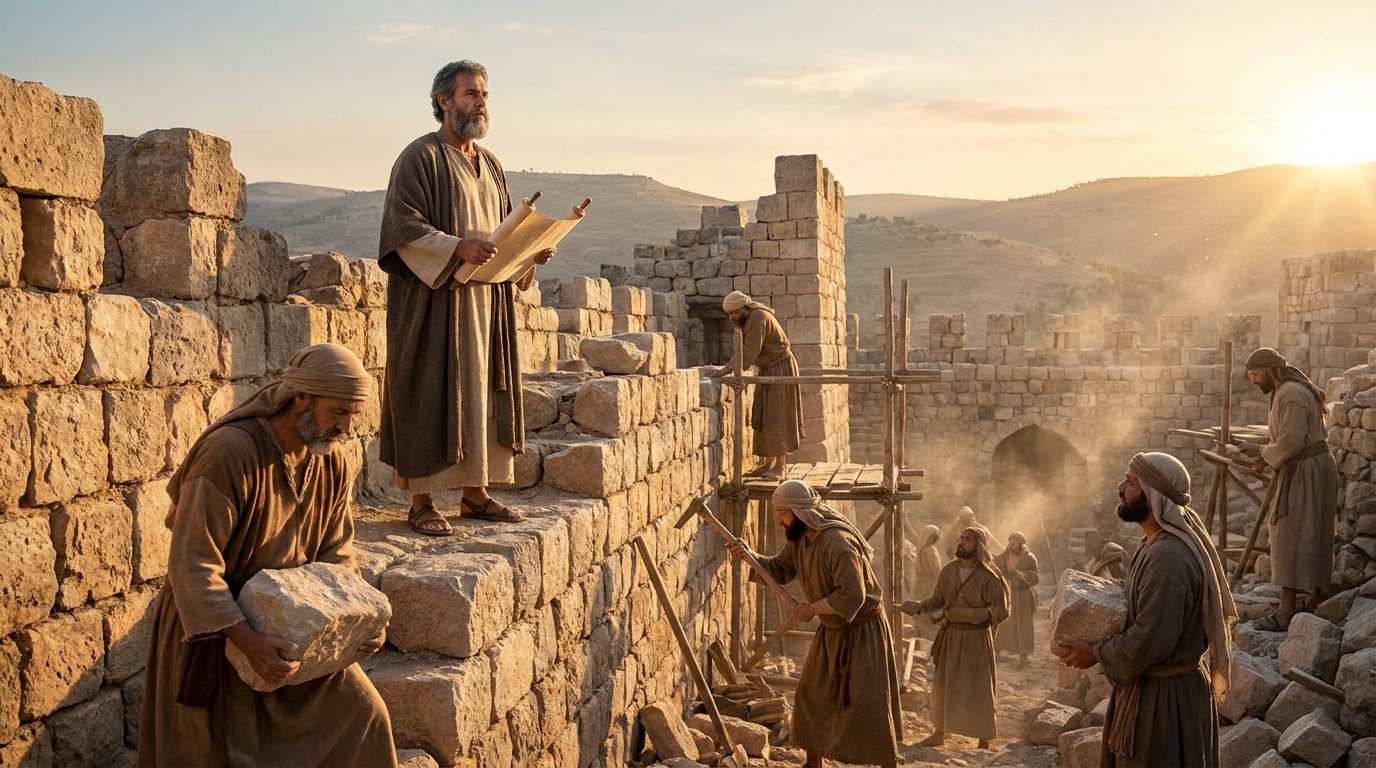
That is why the Old Testament Book of Nehemiah remains one of the most practical, encouraging blueprints for spiritual perseverance in all of Scripture. Serving as royal cupbearer to King Artaxerxes in faraway Persia, Nehemiah heard that the protective walls of Jerusalem still lay in ruins and its gates were burned with fire. Moved by holy compassion, he traded palace comfort for hard hats and rubble—rallying a weary remnant to rebuild the entire stone perimeter of Jerusalem in just fifty-two days (Nehemiah 6:15).
📖 Key Biblical Passages in the Book of Nehemiah
- Nehemiah 1:1–11 & 2:1–8: Nehemiah spends four months fasting and praying over Jerusalem’s ruins before breathing a quick arrow prayer and receiving the king’s favor.
- Nehemiah 2:11–20 & 3:1–32: After inspecting the broken walls privately by night, Nehemiah organizes families to build side-by-side right outside their own homes.
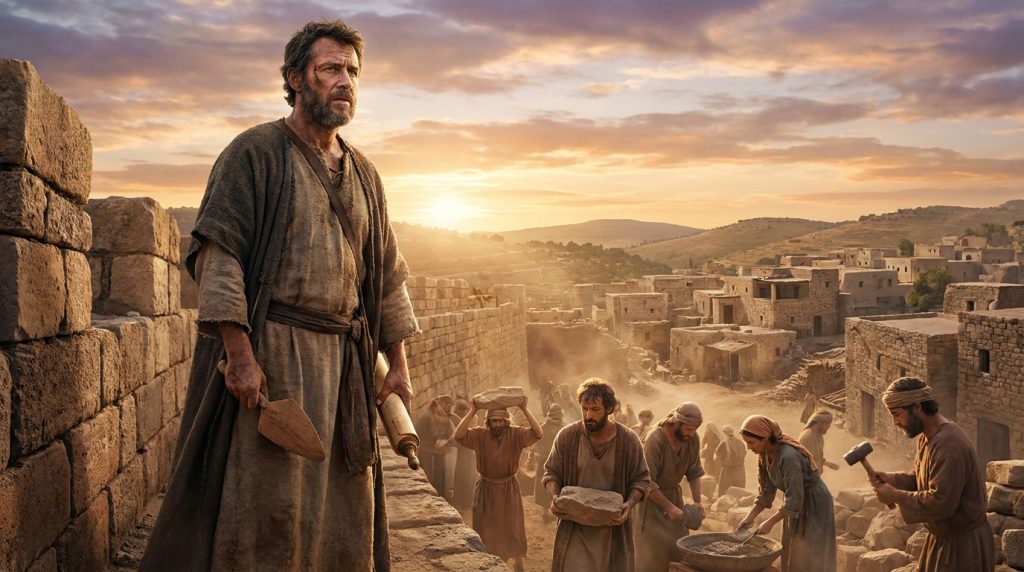
- Nehemiah 4:6–23: When mockery and halfway fatigue strike at the midpoint, the builders work with a trowel in one hand and a sword at their side.
- Nehemiah 6:1–16 & 8:10: Nehemiah refuses to come down from the wall to argue with his critics, completes the work in 52 days, and reminds the people that the joy of the Lord is their strength.
5 Transformative Lessons from Nehemiah on Rebuilding & Perseverance
1. Kneel Before You Build (Months of Prayer + Split-Second Arrow Prayers)
When Nehemiah first received the heartbreaking report about Jerusalem in the month of Kislev (Nehemiah 1:1–4), he didn’t immediately march into the king’s throne room or form a task force. Instead, he sat down, wept, fasted, and prayed for four entire months until the month of Nisan (Nehemiah 2:1).
Then, in Nehemiah 2:4, when King Artaxerxes suddenly asked him what he was requesting, notice what Nehemiah did in that split second between the king’s question and his own reply: he prayed to the God of heaven right on the spot before opening his mouth! Because he had spent months soaking in deep intercession, he could whisper a two-second “arrow prayer” in a moment of pressure—showing how a consistent morning Christian prayer habit prepares us for unexpected doors of opportunity.
2. Survey the Rubble Honestly—Then Start Right in Front of Your Own House
Upon arriving in Jerusalem, Nehemiah took three quiet days and rode out at night with a few companions to inspect the broken walls firsthand before making any speeches (Nehemiah 2:11–16). Wisdom never denies how broken a situation is; it looks honestly at the rubble in the light of God’s promises.
And how did they tackle a massive city-wide restoration project without getting overwhelmed? In Nehemiah chapter 3, Nehemiah assigned Priests, goldsmiths, perfumers, and families—including Shallum and his daughters (Nehemiah 3:12)—to repair the section of the wall right in front of their own houses (Nehemiah 3:28)! You don’t have to fix the whole world at once; simply start laying bricks faithfully right where God has planted your family today.
3. Beating the “Halfway Fatigue” Trap (Nehemiah 4:6–14)
Have you ever noticed when discouragement hits hardest in any worthwhile effort? Look at Nehemiah 4:6 and 4:10: the wall was joined together to half its height, and right at the halfway point, the workers of Judah cried out that their strength was giving out and there was simply too much rubble left to finish.
At the halfway mark, the initial adrenaline of starting has worn off, your muscles are sore, and the finish line still feels miles away. How did Nehemiah revive their weary hearts? In Nehemiah 4:14, he told them to take their eyes off the piles of broken stone and remember the Lord, who is great and awesome—the exact shift in focus we practice when we pray for strength in hard seasons.
4. A Trowel in One Hand and a Sword at Your Side
When external critics like Sanballat and Tobiah realized mockery wouldn’t stop the builders, they threatened to attack the work (Nehemiah 4:7–8). Nehemiah responded in verse 9 by combining two things that always belong together in the Christian life: they prayed to their God, and they posted a guard day and night.
From that day on, the builders worked with one hand holding a mason’s trowel to lay stones and the other hand holding a weapon (Nehemiah 4:17–18). In your own home and faith walk, practical daily faithfulness (the trowel) and spiritual vigilance through the Armor of God and the Sword of the Spirit work hand in hand.
5. “I Am Doing a Great Work and Cannot Come Down” (Nehemiah 6:3)
When the wall was almost finished and only the wooden doors remained to be hung in the gates, Nehemiah’s enemies tried one final tactic: distraction. Four separate times in Nehemiah 6:1–4, Sanballat and Geshem sent polite invitations urging Nehemiah to leave Jerusalem and meet them down in the villages on the plain of Ono.
Nehemiah saw right through the time-wasting trap and sent back the same calm, boundary-setting reply four times in a row (Nehemiah 6:3): he was carrying on a great work and could not come down—asking why the work should stop while he left it to go down to them.
If the enemy cannot defeat you through outright opposition, he will try to pull you off the wall through petty drama, comparison, and endless distractions. Guard your calling, your family peace, and your quiet time with that exact same resolve!
🌿 A Quiet-Time Reflection & Breath Prayer for Today
If you are standing at the “halfway mark” of a long rebuilding season and feeling tired, lift your eyes from the rubble to your Redeemer:
- Inhale slowly: “Lord, the joy of the Lord is my strength today (Nehemiah 8:10)…”
- Exhale in focus: “…I am doing a great work with Your help, and I will not come down.”
Stay anchored in daily prayer as you build with our 30-Day Christian Prayer Journals or our guided Walking in Grace 52-Week Devotional.
Read Next: Lead Like Joshua — Courage and Faith in Action →Frequently Asked Questions About Nehemiah in the Bible
What was a royal cupbearer in the Book of Nehemiah?
In the ancient Persian court, the royal cupbearer (Nehemiah 1:11) was far more than a butler—he tasted the king’s wine before it touched the monarch’s lips to guard against assassination by poison. Because the king entrusted his very life to him daily, the cupbearer enjoyed rare, intimate access to the king as a trusted advisor.
How long did it take Nehemiah to rebuild the walls of Jerusalem?
Although Jerusalem’s walls had lain broken down for roughly 140 years since the Babylonian conquest, Nehemiah 6:15–16 records that once the people united in prayer and organized teamwork, the wall was completed in just 52 days—causing surrounding nations to recognize that the work had been accomplished by the help of God.
What “broken wall” or God-given calling are you rebuilding in this season of your life? Share in the comments below so we can pray for your strength!

