Hi friend,
Have you ever felt like you—or someone you love dearly—wandered too far from God to ever be welcomed back with open arms?
When we look back on seasons of spiritual drift, wasted years, or choices we wish we could undo, shame whispers a subtle lie: that even if God agrees not to cast us out, He will at best tolerate us on the back porch as second-class hired servants. We assume we must spend years working off our debt before we can ever feel close to the Father again.
To shatter that legalistic lie forever, Jesus told what is widely regarded as the greatest short story in human history in Luke 15:11–32: The Parable of the Prodigal Son. Spoken as the climax of three consecutive stories in Luke 15 (following the Lost Sheep and the Lost Coin), this parable isn’t really about one wayward boy—it is about two lost sons (one lost in wild rebellion, the other lost in religious pride) and a compassionate Father who runs down the road to bring them both inside.
📖 Key Biblical Breakdown: The Three Characters of Luke 15:11–32
- The Younger Son (Luke 15:12–19): Demands his share of the estate early, squanders everything in a distant country, and hits rock bottom feeding pigs during a famine before coming to his senses.
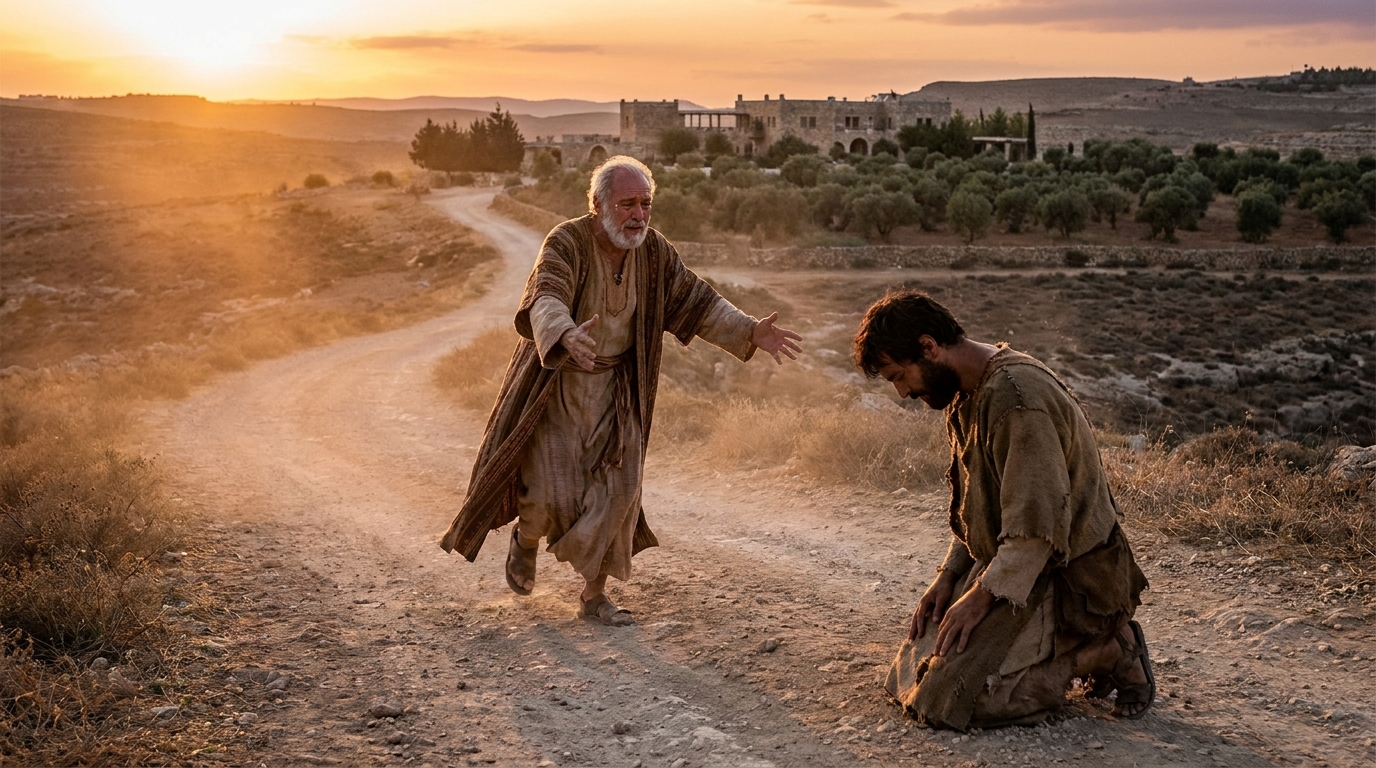
- The Running Father (Luke 15:20–24): Spots his returning son while he is still a long way off, sprints down the road to embrace him, and restores his full sonship with a robe, signet ring, sandals, and feast.
- The Older Brother (Luke 15:25–32): Works dutifully in the fields yet refuses to enter the banquet out of bitter resentment—revealing how self-righteousness can keep a heart distant from the Father’s joy.
4 Transformative Faith Lessons from the Prodigal Son
1. Coming to Your Senses in the Far Country: The Heart of Repentance
In the ancient Near East, asking a healthy father for your inheritance before he died (Luke 15:12) was an unthinkable insult—effectively telling him that you wished he were already gone and only cared about his wealth. Yet the father quietly divided his property and allowed his younger son to walk away.
Notice what happened when the money ran out and a severe famine struck that distant land (Luke 15:14–17): the young man ended up longing to fill his stomach with the carob pods fed to pigs, until verse 17 records the turning point: “When he came to his senses…”
Notice what triggered his return home: he didn’t think about how harsh his father was; he remembered his father’s generosity—that even the lowest hired workers in his father’s house had more than enough bread to eat! As we explore in our study on why Jesus spoke in parables, true repentance always begins when we wake up to the emptiness of the world’s promises and remember the goodness of our Father’s house.
2. Why the Father Ran: Shielding His Child From Public Shame
Look closely at Luke 15:20: while the boy was still a long way off, his father saw him (meaning the father had been scanning the horizon day after day watching for him!), was filled with compassion, ran to his son, threw his arms around his neck, and kissed him repeatedly.
To first-century Jewish listeners, a dignified elder nobleman hiking up his outer robes, exposing his ankles, and sprinting down a dusty village lane was shocking. Why did the father run? Historical scholars note that when a Jewish son squandered family property among Gentiles and returned home in rags, the village townspeople would gather at the gate to perform a public shaming ritual called the kezazah (“the cutting off”), smashing a clay pot in front of him and banishing him in disgrace.
By sprinting out to the edge of town before anyone else could reach his boy, the father absorbed all the public embarrassment himself—wrapping his filthy, pig-stained son in his arms so no villager could lay a finger on him. That is an exact picture of what Jesus did for us on the cross and why God’s forgiveness sets us completely free.
3. The Robe, the Signet Ring, and the Sandals: Zero Probation in Grace
All the way home, the younger son had practiced a three-part speech (Luke 15:18–19): confess his sin, admit he was unworthy to be called a son, and ask to be hired as a day laborer to pay back his debt. Yet when he started reciting his speech in verse 21, the father cut him off before he could even reach the line about becoming a hired servant!
Instead, the father called for three specific items in Luke 15:22 that carried unmistakable legal and family meaning:
- The Best Robe: The father’s own ceremonial garment, covering the boy’s rags and clothing him in the father’s righteousness (Isaiah 61:10).
- The Signet Ring: Pressed into hot wax to sign official family business, restoring the son’s full legal authority in the household.
- Sandals for His Feet: Hired servants and slaves walked barefoot; only freeborn sons and daughters wore sandals in the house.
God never puts a returning believer on spiritual probation. As we see in letting go of guilt and finding restoration in Christ, the moment you come home to Jesus, you are welcomed as a beloved child, never a slave.
4. Guarding Against “Older Brother Syndrome” (Luke 15:25–32)
Why didn’t Jesus end the story at the banquet table in verse 24? Because standing right in front of Him in Luke 15:1–2 were the Pharisees and scribes, grumbling that Jesus welcomed tax collectors and sinners like Zacchaeus.
When the older brother heard music and dancing coming from the house, he stood outside fuming—complaining that he had slaved for his father for years without breaking a rule, yet had never even been given a young goat to celebrate with his friends (Luke 15:28–29). Notice that the older brother was living under the father’s roof, yet he felt like an unpaid employee rather than a cherished son!
Look at how the father treated the older son in verse 28: for the second time in the same day, the father left the party and walked outside to plead with a son—reminding him tenderly in verse 31 that he was always with him, and everything the father owned already belonged to him.
🌿 A Quiet-Time Reflection & Breath Prayer for Today
Whether your heart feels weary from wandering in a distant season or tired from trying to earn God’s smile through religious performance, step inside the Father’s celebration today:
- Inhale slowly: “Father, You run to meet me with compassion and clothe me in grace…”
- Exhale in peace: “…I am Your beloved child, and I rest in Your house today.”
Deepen your daily walk in the Father’s love with our printable 30-Day Christian Prayer Journals or our Walking in Grace 52-Week Devotional.
Read Next: Why Did Jesus Speak in Parables? →Frequently Asked Questions About the Prodigal Son
What does the word “prodigal” actually mean?
Contrary to popular belief, the word prodigal does not mean “wandering” or “wayward”—it means “recklessly extravagant or lavishly wasteful, spending until nothing is left.” While it describes the younger son’s reckless spending in Luke 15:13, Christian writers like Timothy Keller point out that it equally describes our “Prodigal God,” whose grace toward returning sinners is lavish and extravagant beyond measure.
Why did the father kill the fattened calf in Luke 15:23?
In rural first-century Galilee and Judea, meat was rarely eaten at ordinary meals. A prize grain-fed calf was reserved for the highest celebrations, enough to feed an entire village of over a hundred guests—signaling that the entire community was invited to rejoice in the son’s full restoration.
Which part of Luke 15 speaks most deeply to your heart right now—the Father running down the road, the robe and ring, or the Father’s gentle words to the older brother? Share in the comments below!