Hi friend,
Have you ever experienced a sweet “mountaintop moment” with the Lord—a Sunday worship service that moved you to tears, a weekend retreat, or a quiet morning where God’s nearness felt almost tangible—only to step back into a Monday morning valley of laundry piles, stressful emails, and family challenges?
When we come down from a moment of spiritual clarity into the noise of everyday problem-solving, it is easy to wish we could pitch a tent on that peaceful mountaintop and never come down.
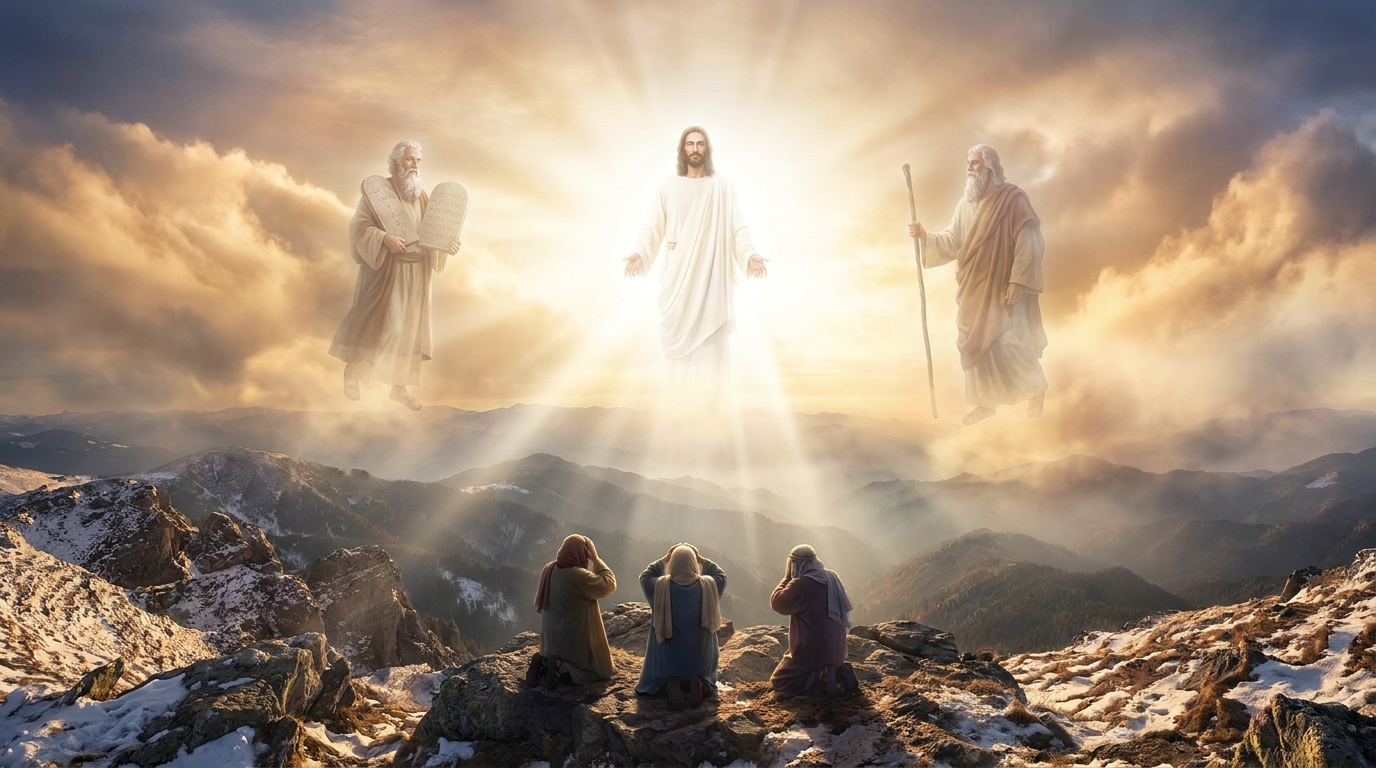
In Matthew 17:1–9 (alongside Mark 9:2–10 and Luke 9:28–36), just six days after Jesus first told His disciples that He must travel to Jerusalem to suffer and die on the cross, He led Peter, James, and John up a high mountain to pray. There, before their astonished eyes, the veil of Jesus’s humble human appearance was briefly pulled back in the Transfiguration—giving three weary fishermen a glimpse of glory that would carry them through the darkest valleys of their lives.
📖 Key Biblical Passages: Matthew 17:1–9 & Luke 9:28–36
- Matthew 17:1–2: Jesus leads Peter, James, and John up a high mountain where He is transfigured (Greek: metamorphothe)—His face shining like the sun and His clothes becoming as dazzling white as light.
- Luke 9:30–31: Moses and Elijah appear in glory, speaking with Jesus about His upcoming “departure” (Greek: exodos—His death and resurrection) in Jerusalem.
- Matthew 17:4–5: As Peter offers to build three shelters, a bright cloud overshadows them and the Father’s voice declares: “This is my Son, whom I love; with him I am well pleased. Listen to him!”
- Matthew 17:6–8: When the terrified disciples fall facedown, Jesus touches them tenderly, tells them not to be afraid, and leads them back down the mountain into ministry.
4 Transformative Lessons from the Mount of Transfiguration
1. Glory Precedes the Cross: Why God Gives Us Mountaintop Moments
To understand why the Transfiguration happened when it did, we have to look just six verses earlier in Matthew 16:21–24. Right after Peter confessed that Jesus was the Messiah, Jesus revealed for the very first time that He was heading to Jerusalem to be rejected, crucified, and raised on the third day—and that His followers would also need to take up their cross and follow Him daily. The disciples were heartbroken and bewildered by that news.
So before leading them down into the valley toward Gethsemane and Calvary, Jesus took His inner circle up the mountain to show them the end of the story ahead of time! By pulling back the curtain to reveal His eternal majesty—a preview of what the Bible says about the Second Coming of Christ—Jesus assured their trembling hearts that the cross was not a tragedy of weakness, but the royal pathway to glory.
2. Why Moses and Elijah Stood Beside Jesus (Luke 9:30–31)
Out of all the heroes of the Old Testament, why did Moses and Elijah appear on the mountain with Jesus? Together, they represented the entire Old Testament Scriptures: Moses stood for the Law, and Elijah stood for the Prophets. Both men had previously encountered God’s glory on mountaintops (Mount Sinai/Horeb), and both pointed forward to the coming Redeemer.
Even more fascinating is the detail Luke preserves in Luke 9:31 about their conversation topic: Moses and Elijah were speaking with Jesus about His “departure” (literally in Greek, His exodos—His Exodus!) which He was about to accomplish at Jerusalem. Just as the first Exodus led Israel out of Egyptian bondage, Jesus was about to accomplish the ultimate Exodus on the cross, freeing humanity from sin and death forever.
3. “Listen to Him!”: Trading Busy Chatter for Quiet Attentiveness
We can always count on Simon Peter to do what so many of us do when we feel overwhelmed: start talking and planning! Not knowing what else to say (Mark 9:6), Peter blurted out an offer to build three shelters—one for Jesus, one for Moses, and one for Elijah (Matthew 17:4).
While Peter was still mid-sentence, the bright cloud of God’s presence enveloped the mountain and the Father gently interrupted him (Matthew 17:5): Jesus is not merely one great teacher on par with Moses and Elijah; He is the beloved Son in whom the Father delights—“Listen to him!” When we quiet our nervous chatter and simply listen to Jesus’s voice in Scripture, our perspective shifts immediately.
4. The Gentle Touch of Jesus That Leads Us Back Into the Valley
Look at the tender contrast between verses 2 and 7 of Matthew 17. In verse 2, Jesus shines with the blinding radiance of the sun; in verse 7, when Peter, James, and John lie facedown on the ground trembling in awe, that same glorious King walks over, touches them with His hand, and whispers: “Get up. Don’t be afraid.”
When they lifted their eyes in verse 8, the cloud had lifted, Moses and Elijah were gone, and “they saw no one except Jesus”—who then walked right back down the mountain trail with them into a noisy crowd where a desperate father was waiting for his son to be healed (Matthew 17:14–18). Mountaintop moments are never meant for permanent camping; God gives us glimpses of His glory in our morning quiet time so we can walk back down into our families and communities carrying His peace.
🌿 A Quiet-Time Reflection & Breath Prayer for Today
Before you step down from your quiet time into the busyness of the “valley” today, let your eyes rest on no one except Jesus:
- Inhale slowly: “Jesus, I quiet my busy thoughts and listen to Your voice…”
- Exhale in peace: “…Your gentle touch removes my fear as we walk into the valley together.”
Capture your mountaintop reflections and daily prayers inside our 30-Day Christian Prayer Journals or our Walking in Grace 52-Week Devotional.
Read Next: What Was Jesus’s Ministry? The Truth About His Purpose →Frequently Asked Questions About the Transfiguration
Which mountain was the Mount of Transfiguration?
Although fourth-century tradition identified Mount Tabor (rising 575 metres above the Jezreel Valley in Lower Galilee) as the site, many biblical geographers point to the slopes of Mount Hermon (soaring over 2,800 metres high just north of Caesarea Philippi, where Jesus and the disciples were located six days earlier in Matthew 16:13) as the “high mountain” described by Matthew and Mark.
Did Peter ever write about the Transfiguration later in his life?
Yes! Decades later, shortly before his martyrdom, an elderly Simon Peter looked back on that unforgettable day in 2 Peter 1:16–18—testifying that he had been an eyewitness of Christ’s majesty and had personally heard the Father’s voice speak from heaven when they were with Him on the sacred mountain.
Have you ever experienced a “mountaintop” moment of clarity in prayer or worship that helped carry you through a hard valley season afterward? Share your story in the comments below!