Hi friend,
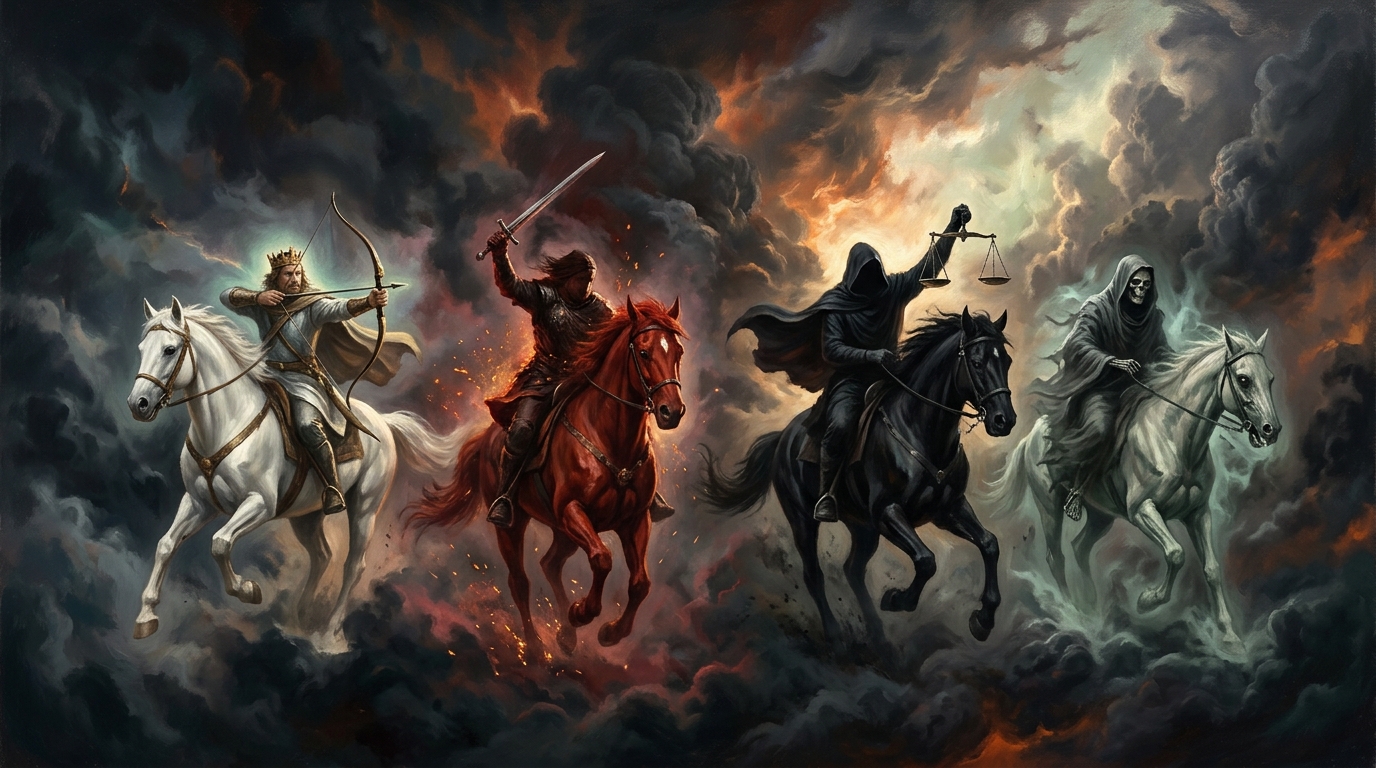
Few images from the Bible have been borrowed, dramatized, and sensationalized by modern pop culture more than the Four Horsemen of the Apocalypse. Because movies and novels often portray these four riders as unstoppable forces of random chaos, many believers feel a knot of apprehension whenever they turn to Revelation 6:1–8.
Yet when we read Revelation 6 in its true scriptural context—right after the throne-room vision of chapter 5 and alongside our companion study on the 7 Seals in Revelation—a remarkably comforting truth comes into focus: not a single horseman can take one step until the Lamb of God breaks the seal and one of the four living creatures around God’s throne gives the command to ride forth.
Far from showing a world spinning out of God’s reach, the opening of the first four seals in our Book of Revelation study series for women demonstrates that Jesus Christ holds sovereign authority over every season of human history.
📖 Quick Timeline: The Four Horsemen of Revelation 6:1–8
- The White Horse (Revelation 6:1–2): Rider with a bow and victor’s wreath → Represents counterfeit peace, spiritual deception, and bloodless conquest.
- The Fiery Red Horse (Revelation 6:3–4): Rider granted a great sword → Represents human conflict, division, and warfare when peace is lifted from the earth.
- The Black Horse (Revelation 6:5–6): Rider holding a pair of measuring scales → Represents economic inflation and food scarcity (1.1 litres of wheat for a day’s wage), yet strictly bounded by God’s command not to harm the olive oil and wine.
- The Pale Green Horse (Revelation 6:7–8): Rider named Death with Hades following → Represents widespread mortality and plague, yet strictly limited by God to one-fourth of the earth.
Examining the Four Horsemen in the Light of Scripture
1. The White Horse: Discerning Counterfeit Peace From the True King (Revelation 6:1–2)
When the Lamb breaks the first seal in Revelation 6:1–2, John sees a white horse whose rider carries a bow, receives a wreath crown, and rides out bent on conquest. At first glance, some readers wonder if this rider on a white horse is Jesus—since Jesus Himself rides a white horse at His glorious return in Revelation 19:11–16.
However, comparing Revelation 6 with Revelation 19 reveals a striking contrast between a counterfeit ruler and the true Savior:
- Who Opens the Seal: In Revelation 6:1, Jesus (the Lamb) is standing in heaven holding the scroll and breaking the seal—distinguishing Him from the four riders who are summoned afterward.
- The Crown Worn: The rider in Revelation 6:2 wears a single stephanos (a temporary woven conqueror’s wreath that had to be given to him), whereas Jesus in Revelation 19:12 wears many royal diademata (permanent monarch crowns of absolute sovereignty).
- The Weapon Carried: The rider in Revelation 6:2 holds a distant bow (notice no arrows are even mentioned—pointing to diplomatic coercion and false peace treaties), whereas Jesus in Revelation 19:15 wields the sharp sword of His spoken Word.
Just as Jesus warned first against false christs in His Mount of Olives discourse (Matthew 24:4–5), the first horseman pictures the deceptive counterfeit peace of the Antichrist. Anchoring your daily quiet time in Scripture keeps your heart discerning and unshaken by cultural counterfeits.
2. The Fiery Red Horse: Living as Peacemakers in a Divided World (Revelation 6:3–4)
Counterfeit peace built apart from the Prince of Peace never lasts for long. When the second seal is opened in Revelation 6:3–4, a bright red horse rides out whose rider is permitted to remove peace from the earth and wield a great sword of conflict and bloodshed.
Notice the recurring phrase across these verses: the rider is permitted or given authority—reminding us that human hostility only occurs when God temporarily lifts His restraining hand so humanity sees the fruit of rejecting His rule. And how are we called to live when the world around us grows angry and polarized? As we explore in our study of the Beatitudes and heart peace, Jesus calls His daughters to be active peacemakers (Matthew 5:9) who carry the calm fragrance of Christ into every room we enter.
3. The Black Horse: Trusting Our Provider During Economic Shaking (Revelation 6:5–6)
Warfare in the ancient world was almost always followed by disrupted harvests and soaring food prices. Under the third seal in Revelation 6:5–6, a black horse appears whose rider holds a pair of balance scales used for weighing scarce grain by hand. A voice from among the four living creatures announces that a single choinix of wheat (approximately 1.1 litres, the daily grain ration required to sustain one working adult) or three choinikes of coarse barley (approximately 3.2 litres, used by families to feed a household) will cost an entire silver denarius—a full day’s wage!
Yet right inside that sobering picture of inflation, notice the protective boundary spoken from the throne in verse 6: a strict command not to harm the olive oil and the wine. Even in seasons of scarcity, God sets a precise ceiling on economic hardship. As Jesus taught in the Sermon on the Mount antidotes for anxiety (Matthew 6:25–34), our security never rests in fluctuating markets—it rests in our Heavenly Father who knows every need of our homes before we ask.
4. The Pale Horse: Why Death Never Has the Final Word for the Believer (Revelation 6:7–8)
When the fourth seal is broken in Revelation 6:7–8, a pale greenish-gray horse (Greek: chloros, the pale hue of withered grass) rides out, carrying a rider named Death with Hades following behind. Combining the effects of the previous riders—conflict, famine, plague, and wild beasts—their authority is strictly restricted to one-fourth of the earth.
Why had the Four Horsemen already appeared in miniature centuries earlier in the Old Testament visions of Zechariah 1:8–11 and 6:1–8? Because in Zechariah’s prophecy, the four colored horses were heavenly patrols sent out by the Lord of all the earth to show that every corner of the globe answers to God! And for every woman whose faith is anchored in Jesus—who declared in His 7 “I AM” statements that He is the Resurrection and the Life, and who holds the keys of Death and Hades in His own hand (Revelation 1:18)—even the fourth horseman has already been defeated at the empty tomb.
🌿 A Quiet-Time Reflection & Breath Prayer for Today
Whenever news of global conflict, inflation, or uncertainty tries to stir up fear in your chest, remember Who holds the reins and sets the boundaries over all creation:
- Inhale slowly: “Lord Jesus, You hold the keys of history and set every boundary…”
- Exhale in trust: “…I will not fear the noise of the world, for my life is hidden in You.”
Keep your morning quiet time anchored in God’s unchanging promises with our printable 30-Day Christian Prayer Journals or our Walking in Grace 52-Week Devotional.
Read the Full Overview: All 7 Seals in Revelation Explained →Frequently Asked Questions About the Four Horsemen
Where in the Bible are the Four Horsemen of the Apocalypse found?
The Four Horsemen appear in Revelation 6:1–8, corresponding to the opening of the first four of the seven seals on the scroll held by the Lamb. Their imagery also draws on Old Testament prophetic visions of colored horses in Zechariah 1:8–11 and Zechariah 6:1–8, as well as God’s fourfold warning judgments mentioned in Ezekiel 14:21.
What does the Greek word “chloros” mean for the Fourth Horse?
In Revelation 6:8, the word translated “pale” is the Greek adjective chloros (from which we get our English words chlorophyll and chlorine)—describing a yellowish-green, ashen color associated with blighted vegetation or severe physical sickness.
How does knowing that even the Four Horsemen cannot move apart from the Lamb’s permission change the way you view unsettling world headlines? Share your thoughts in the comments below!