Hi friend,
In everyday conversation, the word “Armageddon” has been hijacked by Hollywood disaster movies to mean an asteroid hitting the planet, a nuclear winter, or the chaotic end of human civilization where nobody survives.
Yet if you look up the word Armageddon in a biblical concordance, you might be surprised to discover that it appears only once in the entire Bible (in Revelation 16:16)—and it doesn’t describe the destruction of the planet at all! Instead, when we trace the Hebrew geography of Har-Magedon and read its fulfillment in Revelation 19:11–21, we discover that Armageddon is the exact opposite of helpless human despair: it is the moment the returning King of Kings ends human tyranny with a single spoken word.
📖 Quick Timeline: How the Bible Unfolds Armageddon (Revelation 16 & 19)
- The Gathering at Har-Magedon (Revelation 16:12–16): Under the sixth bowl, rebellious kings assemble their forces in the staging ground called in Hebrew Armageddon (Mount Megiddo / the Jezreel Valley) for “the battle on the great day of God Almighty.”
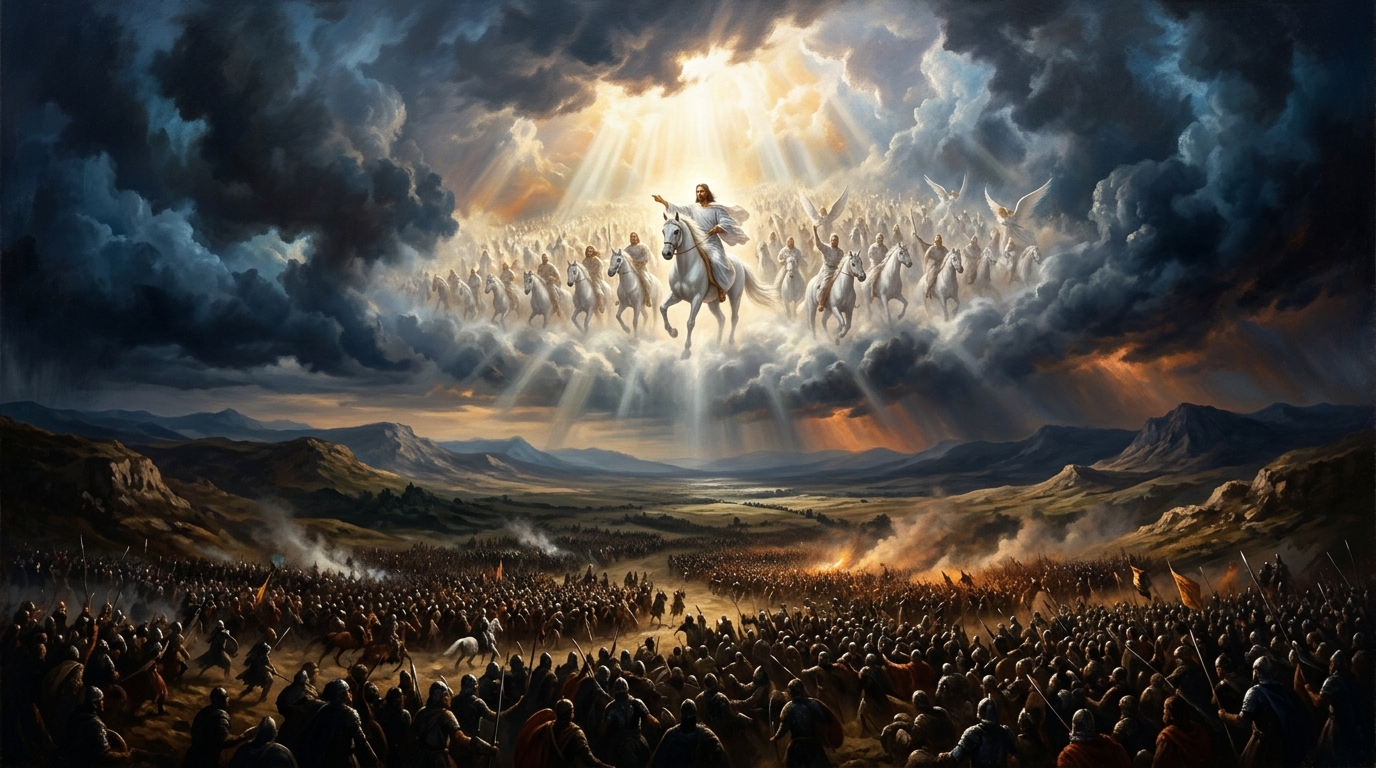
- Heaven Opens in Glory (Revelation 19:11–13): Jesus Christ rides forth from heaven on a white horse as “Faithful and True,” wearing many royal crowns and a robe dipped in His own redeeming blood, called “the Word of God.”
- The Armies of Heaven Follow (Revelation 19:14): Clothed in fine, white, clean linen, the redeemed armies of heaven ride behind Him—without carrying a single weapon!
- Victory by the Spoken Word (Revelation 19:15–21): Without a drawn-out contest, the rebellion of the beast and false prophet is ended instantly by the sharp sword of the Word proceeding from Christ’s mouth, ushering in His Millennial Kingdom.
4 Biblical Truths That Replace Armageddon Myths With Peace
1. What “Har-Magedon” Actually Means in Biblical Geography (Revelation 16:16)
In Revelation 16:16, John notes explicitly that the gathering place is called in Hebrew Armageddon (Har-Magedon)—combining the Hebrew word Har (“Mountain or Hill”) with Megiddo. Located roughly 97 kilometres north of Jerusalem and 29 kilometres southwest of the Sea of Galilee, the ancient fortress mound of Megiddo guards the strategic mountain pass overlooking the vast, triangular plain of the Valley of Jezreel (also called the Plain of Esdraelon), stretching down from the ridge of Mount Carmel.
Why does the Holy Spirit point us to the landscape around Megiddo and Mount Carmel? Because every Bible reader who knows the Old Testament recognizes that exact valley as the place where God repeatedly defeated impossible odds on behalf of His people:
- It was right by the waters of Megiddo (Judges 5:19) that God sent a downpour to rout Sisera’s 900 iron chariots for Deborah and Barak!
- It was right in that same Valley of Jezreel (Judges 6:33) that God used Gideon and just 300 men holding clay jars and torches to defeat a Midianite multitude!
- And it was right on the overlooking ridge of Mount Carmel that God answered Elijah’s prayer with fire from heaven!
In Scripture, “Armageddon” is shorthand for the place where arrogant human armies think they have God’s people outnumbered—only for the Almighty to step in and win the victory Himself.
2. Whose Day Is It? “The Great Day of God Almighty” (Revelation 16:14)
Read the wording of Revelation 16:14 carefully: the deceptive spirits gather the kings of the whole world not for man’s day or the enemy’s day, but “for the battle on the great day of God Almighty.”
Just as Psalm 2:1–6 prophesied centuries earlier—asking why the nations rage and the kings of the earth band together against the Lord and His Anointed One, while the One enthroned in heaven laughs and installs His King on Zion—Armageddon is never a nail-biting contest where good and evil are evenly matched. Darkness is not an equal opposite to Jesus; Jesus is the Creator, and darkness flees the moment the Light of the World appears.
3. Why Jesus’s Robe Is Dipped in Blood *Before* the Battle Starts (Revelation 19:11–14)
When heaven opens in Revelation 19:11–16 to reveal the Second Coming of Christ, look closely at the sequence of verses 13 and 14. Before a single clash occurs on earth, Jesus rides out wearing a robe already “dipped in blood,” and His name is called the Word of God (verse 13). Meanwhile, the armies of heaven riding behind Him are dressed in “fine linen, white and clean” (verse 14—which verse 8 just told us is the righteous garments of the saints!).
Notice two remarkable details in that picture: first, the saints riding behind Jesus don’t carry a single sword, shield, or spear, and their white linen robes never get a single speck of blood on them! Second, Jesus’s robe is already stained with blood before He leaves heaven—pointing both to the prophetic fulfillment of Isaiah 63:1–3 and to the precious blood He shed on the cross of Calvary, where He already disarmed the powers and authorities (Colossians 2:15).
4. Victory by a Single Spoken Word (Revelation 19:15, 21)
How does the actual confrontation of Armageddon end in Revelation 19:15 and 19:19–21? Look at the text: there is no prolonged battle scene at all! In verse 19, the beast and the kings of the earth gather their armies to wage war against the Rider on the horse; in verse 20, the beast and the false prophet are immediately seized; and in verse 15 and 21, the rebellion is ended by the sharp sword coming out of Christ’s mouth—His spoken Word!
As the Apostle Paul wrote in 2 Thessalonians 2:8, the Lord Jesus will overthrow the lawless one simply “with the breath of his mouth and destroy him by the splendor of his coming.” The very same voice that said “Let there be light” in Genesis 1 and “Peace, be still” on the stormy Sea of Galilee will speak a single word of truth, and every counterfeit empire will vanish before the King of Kings and Lord of Lords (Revelation 19:16).
🌿 A Quiet-Time Reflection & Breath Prayer for Today
Never let Hollywood’s version of “Armageddon” rob your peace—in the Bible, Armageddon is the day our Faithful and True King returns to end all war forever:
- Inhale slowly: “Lord Jesus, You are Faithful and True, the King of Kings…”
- Exhale in confidence: “…one word from Your mouth wins every battle, and my heart rests in You.”
Wield the Sword of the Spirit—the Word of God—in your daily prayer life using our 30-Day Christian Prayer Journals or our Walking in Grace 52-Week Devotional.
Read Next: What the Bible Says About the Second Coming of Christ →Frequently Asked Questions About the Battle of Armageddon
Why does Revelation 16:16 say “Mount” Megiddo when Megiddo sits beside a valley?
While the troop staging ground stretches across the flat Valley of Jezreel below, ancient Tel Megiddo itself is a raised, 21-metre-high fortress mound (a tel built up over twenty-six layers of ancient cities) sitting directly at the foot of the Mount Carmel mountain range—connecting the mountain stronghold of Deborah, Gideon, and Elijah with the broad plain beneath it.
What are the four names of Jesus recorded at His return in Revelation 19:11–16?
In Revelation 19:11–16, John records four glorious titles of the returning Christ: 1) He is called “Faithful and True” (verse 11); 2) He has a sacred name written on Him “that no one knows but he himself” (verse 12); 3) His name is called “the Word of God” (verse 13); and 4) on His robe and on His thigh is written the supreme title: “KING OF KINGS AND LORD OF LORDS” (verse 16)!
Which detail from Revelation 19—Jesus being called “Faithful and True,” the saints dressed in clean white linen without weapons, or victory by a single spoken word—gives you the greatest peace today? Share below!