Hi friend,
Does the phrase “the judgment seat of Christ” in 2 Corinthians 5:10 ever make your stomach tighten—wondering if standing before Jesus in heaven means watching a giant replay screen of every mistake you ever made while everyone looks on in disappointment?
If that fearful picture has ever crossed your mind, take a deep, peaceful breath today: that is not what the Bible teaches about the believer’s homecoming! Because our English Bibles translate two completely different Greek words using the single word “judgment,” many Christians accidentally mix up the final sentencing of the lost with the joyful rewards table of the redeemed.
When the Apostle Paul wrote to the believers in Corinth about appearing before the Judgment Seat of Christ (Romans 14:10; 2 Corinthians 5:10), the Greek word he used was Bema—the exact word every Corinthian knew as the raised awards platform at the athletic games where victorious runners received their crowns!
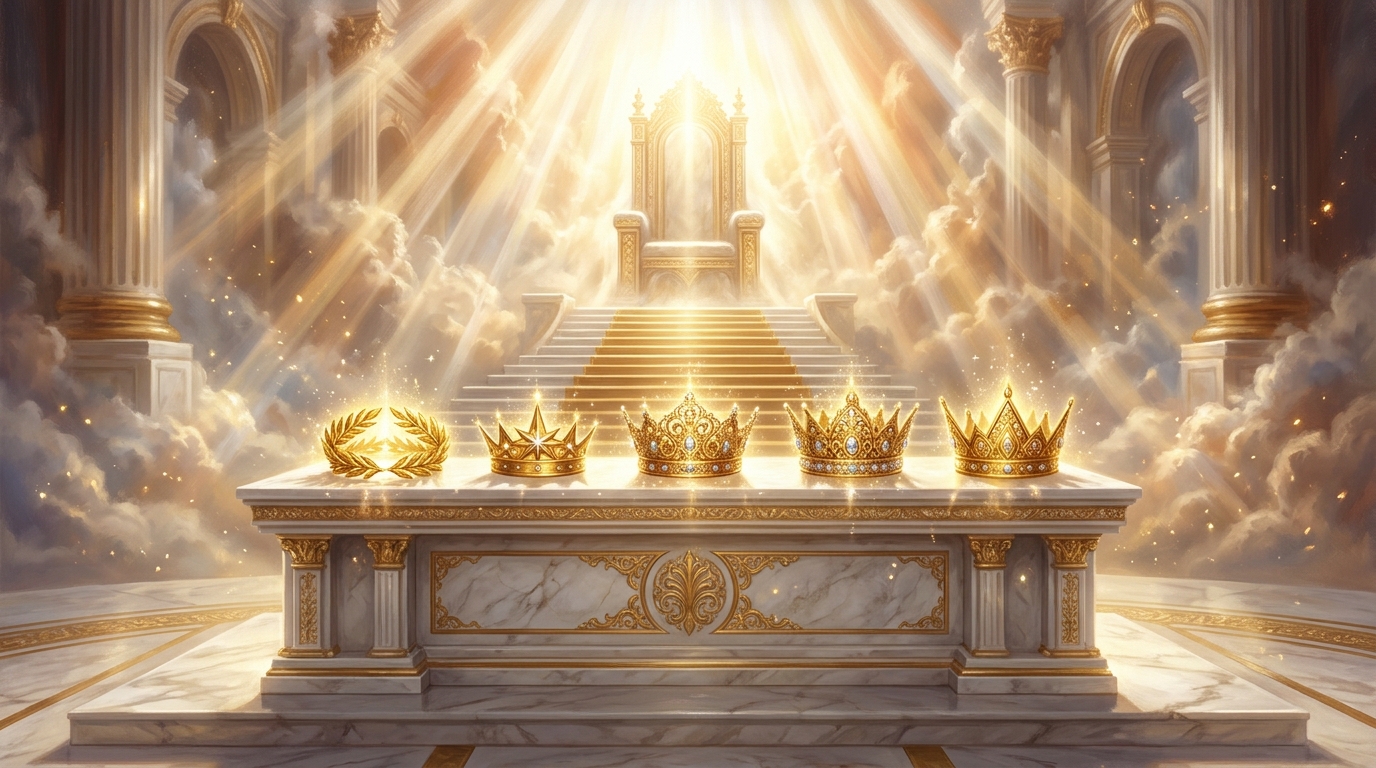
📖 Quick Overview: The 5 Heavenly Crowns Promised to Believers
- The Imperishable / Incorruptible Crown (1 Corinthians 9:24–25): Promised to believers who run their earthly race with faithful endurance and self-control → Never withers like ancient celery or laurel wreaths.
- The Crown of Rejoicing (1 Thessalonians 2:19): Often called the Soul-Winner’s or Encourager’s Crown → Given for investing in people and pointing others to Jesus.
- The Crown of Righteousness (2 Timothy 4:8): Promised not only to apostles like Paul, but to “all who have longed for his appearing” → Rewards a heart that loves and looks forward to Christ’s return.
- The Crown of Life (James 1:12 & Revelation 2:10): Promised to those who persevere under trial and remain faithful through suffering because they love the Lord → Honors steadfast trust in hard seasons.
- The Unfading Crown of Glory (1 Peter 5:2–4): Promised by the Chief Shepherd to humble spiritual leaders, mentors, and parents who willingly care for the flock under their roof → Honors quiet, servant-hearted shepherding.
4 Liberating Biblical Truths About the Bema Seat of Christ
1. The Bema Seat vs. The Great White Throne: Why Salvation Is Never on Trial
To read end-times prophecy with total confidence (as we explore in our pillar guide on Understanding the Book of Revelation for Women), we must always keep two biblical events distinct:
- The Judgment of Sin at the Cross (Past — Settled Forever for Believers): In John 5:24, Jesus promised that whoever hears His word and believes Him who sent Him has eternal life and “will not be judged, but has crossed over from death to life.” Every single one of your sins—past, present, and future—was already judged and paid in full when Jesus cried “It is finished!” on the cross (Romans 8:1: “There is now no condemnation for those who are in Christ Jesus”).
- The Bema Seat of Christ (Future — For Believers Only, 2 Corinthians 5:10): Unlike the Great White Throne at the end of Revelation 20:11–15 (where those who rejected Christ are judged), the Bema Seat has zero to do with whether you enter heaven—everyone standing at the Bema Seat is already safely home in heaven! Instead, like the raised stone Bema platform that still stands in the archaeological ruins of ancient Corinth today (where Priscilla, Aquila, and Paul lived in Acts 18), it is the podium where the Master commends and rewards His servants’ stewardship.
2. Gold, Silver & Precious Stones vs. Wood, Hay & Straw (1 Corinthians 3:11–15)
In 1 Corinthians 3:11–15, Paul gives us our clearest picture of what happens at the Bema Seat. Every believer stands on the exact same unshakeable foundation—Jesus Christ (verse 11). As we live out our Christian walk each day, we build on that foundation using two kinds of materials: either gold, silver, and precious stones, or wood, hay, and straw (verse 12).
Notice that on the Day of Christ, the fire does not touch the believer—the fire only tests the quality and motive of the work (verse 13)! What is the difference between “wood, hay, and straw” and “gold, silver, and precious stones”?
Wood, hay, and straw are bulky and impressive from a distance, yet they burn up into ash because they represent things done out of selfish ambition, people-pleasing, or wanting to be seen by the crowd. In contrast, gold, silver, and gems are often small and hidden from public view, yet fire only makes them shine brighter—representing every quiet prayer you whispered in secret, every cup of cold water you gave in Jesus’s name (Matthew 10:42), and every hidden sacrifice you offered out of pure love for the Lord (just like the poor widow’s two tiny coins in Mark 12).
3. God Remembers the Unseen Faithfulness the World Forgot (1 Corinthians 4:5)
Look at the comforting promise tucked right after the Bema passage in 1 Corinthians 4:5: when the Lord comes, He will bring to light what is hidden in darkness and will expose the motives of the heart—and “at that time each will receive their praise from God.”
Did you catch those last five words? Each will receive their praise from God! Every night you stayed up comforting a sick child, every time you chose forgiveness over bitterness when no one else knew how deeply you were hurt, and every faithful “two-talent” assignment you stewarded in your kitchen or workplace (like the servants in the Parable of the Talents) has been recorded in heaven’s ledger to be honored openly by your Savior.
4. Why Do We Receive Crowns? To Cast Them at Jesus’s Feet (Revelation 4:10–11)
Sometimes humble Christian women wonder: “Isn’t wanting a heavenly crown selfish? Isn’t just being with Jesus in heaven reward enough?”
Look at what the twenty-four elders do with their golden crowns in Revelation 4:10–11: they don’t strut down the streets of gold comparing who has the tallest crown! Instead, they fall down before Him who sits on the throne, cast their crowns before the throne, and cry out that the Lord alone is worthy to receive all glory, honor, and power!
The joy of receiving a crown at the Bema Seat isn’t so we can boast in ourselves—it is so that on that great day of worship, our hands won’t be empty when we kneel to lay a token of gratitude at the nail-pierced feet of the Savior who gave everything for us.
🌿 A Quiet-Time Reflection & Breath Prayer for Today
Never think that your quiet, unseen acts of love in your home or church go unnoticed—your Master sees in secret and is preparing your *”Well done”*:
- Inhale slowly: “Lord Jesus, there is no condemnation for me because of Your cross…”
- Exhale in joy: “…help me build today with the pure gold of love for Your glory alone.”
Stay anchored in eternal priorities each morning inside our printable 30-Day Christian Prayer Journals or our Walking in Grace 52-Week Devotional.
Read Next: The Parable of the Talents — Living for ‘Well Done’ →Frequently Asked Questions About the Bema Seat Judgment
What does the word “bad” or “worthless” mean in 2 Corinthians 5:10?
In 2 Corinthians 5:10 (“whether good or bad”), Paul deliberately avoids the usual Greek words for moral evil or sin (kakos or poneros, since our sins were already judged at the cross) and instead uses the word phaulos—which means “lightweight, trivial, or good-for-nothing” (like the wood, hay, and straw of 1 Corinthians 3:12 that simply burns away as wasted time while the believer herself is saved and secure).
What is the difference between a “stephanos” crown and a “diadema” crown?
Every single one of the five crowns promised to believers in the New Testament uses the Greek word stephanos—the victor’s wreath placed on the head of an athlete who finishes the race—whereas the royal monarch’s crown (diadema) belongs uniquely to Jesus as King of Kings (Revelation 19:12).
How does knowing that the Bema Seat is a place of affirmation and reward—rather than condemnation—change the way you feel about standing before Jesus one day? Share your thoughts below!