Hi friend,
Have you ever looked at the smallness of what you had to offer God at the end of a busy week—whether a modest financial gift, five quiet minutes of prayer, or a simple meal brought to a neighbor—and felt like your contribution was too tiny to matter?
In a world obsessed with big numbers, large platforms, and flashy gestures, it is easy to talk ourselves out of offering the small gifts in our hands.
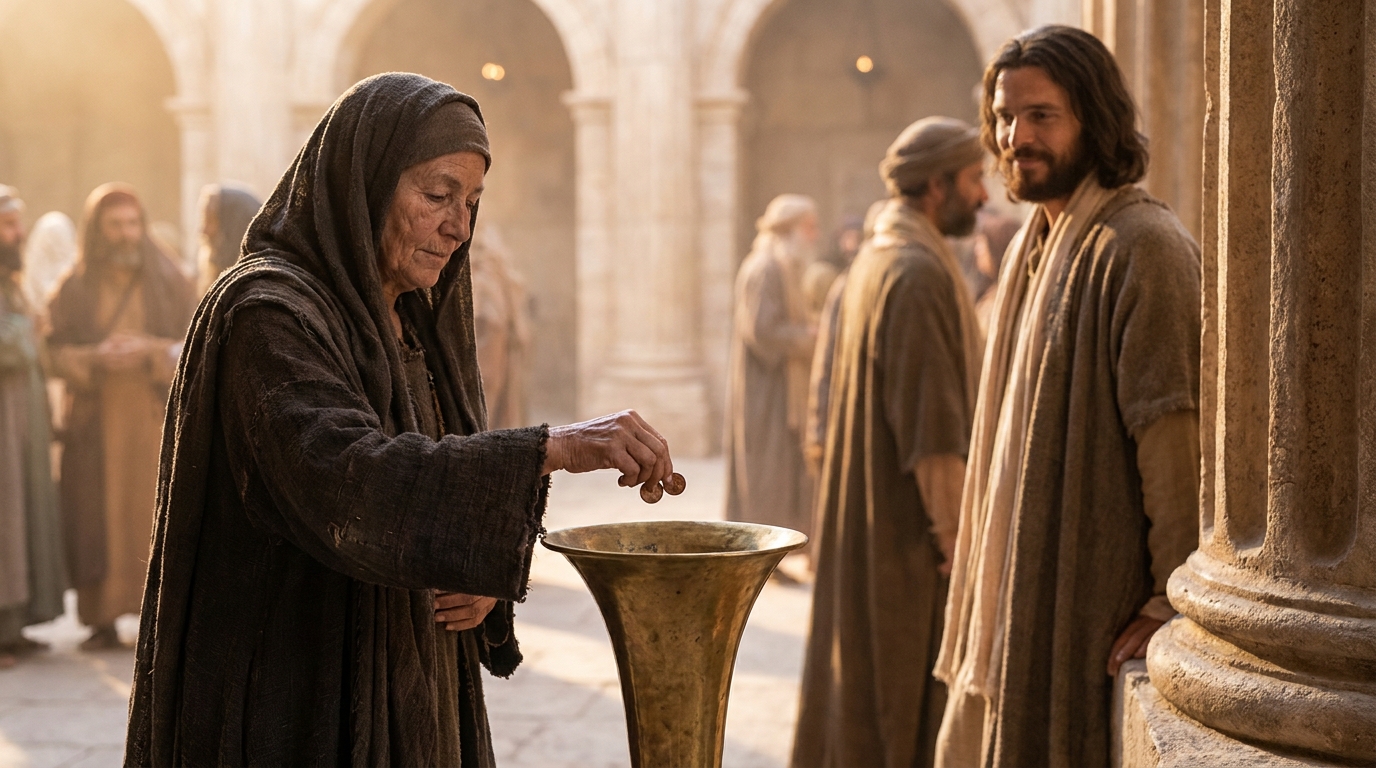
Yet during the final week of Jesus’s earthly ministry before the cross, after hours of intense public debates with the religious elite in the Jerusalem Temple, Jesus sat down across from the Temple treasury in Mark 12:41–44 (and Luke 21:1–4). Out of all the thousands of Passover pilgrims filing past the offering chests that afternoon, only one person caused Jesus to call His twelve disciples over for an urgent object lesson: an unnamed, impoverished widow who quietly dropped in two paper-thin bronze coins.
📖 Key Biblical Passage: Mark 12:41–44 & Luke 21:1–4
- The Setting (Mark 12:41): Sitting in the Court of the Women opposite the thirteen horn-shaped bronze treasury chests, Jesus watches the crowd—noticinghow people give, not merely what they give.
- The Offering (Mark 12:42): While many wealthy donors toss in large sums of heavy silver that clatter loudly down the metal chutes, a poor widow steps up and drops in two tiny copper lepta (“mites”), worth a fraction of a Roman cent.
- The Verdict of Heaven (Mark 12:43–44): Summoning His disciples, Jesus declares that this poor widow put more into the treasury than all the others combined—because they gave out of their surplus, while she gave out of her poverty all she had to live on.
4 Transformative Lessons from the Widow’s Two Mites
1. Jesus Sits Opposite the Treasury: He Sees Every Quiet Sacrifice
In the Court of the Women inside Herod’s Temple stood thirteen trumpet-shaped bronze collection chests (called shofarot). When wealthy donors poured handfuls of heavy silver shekels down those flared metal necks, the coins rang out like a brass bell across the marble colonnade, drawing admiring glances from everyone nearby.
In contrast, when this widow stepped up and dropped in two tiny copper lepta (the Greek word lepton literally means “peeled, thin, or tiny”—each coin weighing barely 1.5 grams and worth just 1/128th of a day’s wage!), they barely made a whisper against the bronze. No human priest or bystander noticed her. Yet Jesus saw her (Luke 21:2)! Just as He noticed the young boy’s five small barley loaves that Andrew brought, your unseen sacrifices of love, service, and giving in secret are treasured by the King.
2. Heaven’s Math Measures What Is Kept Back, Not Just What Is Given (Mark 12:43–44)
Look at how completely Jesus flips human accounting upside down in Mark 12:43. He didn’t say the widow gave as much as the wealthy donors—He stated as an absolute spiritual fact that she put in more than all the others!
How can two tiny bronze coins outweigh bags of silver? Because earthly math measures the size of the gift, whereas heaven’s math measures the size of the heart and the proportion of trust! The wealthy contributors gave out of their overflow without changing a single meal or comfort in their week; the widow placed her very next meal into the hands of her Heavenly Father. Whenever your faith or your offering feels too small, remember that God weighs love, never volume.
3. Why She Had *Two* Coins: She Could Have Kept Half Back
Have you ever paused to think about why the Holy Spirit specifically recorded that the widow had two coins rather than one larger coin of the same value?
Because if she had only held a single coin in her palm, her choice would have been all-or-nothing. Having two separate coins meant she could have easily compromised—dropping one coin into the box for God and tucking the second coin back into her purse for security! Instead, out of pure devotion, she opened her fingers and let go of both. In the original Greek of Mark 12:44, when Jesus says she put in “all she had to live on,” the words are literally holon ton bion autes—“her whole life.”
4. How the Widow’s Offering Foreshadowed What Jesus Did Three Days Later
Look at where the story of the poor widow sits in the Gospel of Mark: it is the very last scene of Jesus’s public ministry inside the Temple courts (Mark 12:41–44) before He steps out onto the Mount of Olives in Mark 13 and walks toward Gethsemane and Calvary in Mark 14–15.
Why did watching this nameless widow move Jesus’s heart so deeply just days before Good Friday? Because in a noisy Temple filled with religious showmanship and self-preservation, she was the only person in the room mirroring what Jesus Himself was about to do on the cross! Three days later, Jesus on the cross held nothing back—pouring out His whole life to redeem us.
🌿 A Quiet-Time Reflection & Breath Prayer for Today
Never hold back your small prayers, quiet acts of kindness, or modest gifts out of embarrassment—in the hands of Jesus, two tiny coins have inspired the world for two thousand years:
- Inhale slowly: “Lord, You look at the love of my heart, not the size of my hands…”
- Exhale in surrender: “…I joyfully place my whole life and trust into Your care today.”
Begin each day offering your heart to the Lord inside our printable 30-Day Christian Prayer Journals or our Walking in Grace 52-Week Devotional.
Read Next: Anna the Prophetess — Faithful Waiting in the Temple →Frequently Asked Questions About the Widow’s Two Mites
What was a “mite” (lepton) worth in the Bible?
In first-century Judea, the bronze lepton (translated “mite” in the King James Version from an old Flemish word for a tiny coin) was the smallest denomination minted. Two lepta equaled one Roman quadrans—which was just 1/64th of a silver denarius (a day’s wage), enough to buy only a tiny handful of flour or two small sparrows (Luke 12:6).
Why does Mark place the widow’s story right after Jesus’s warning in Mark 12:38–40?
In Mark 12:38–40, Jesus warned against corrupt scribes who paraded around in flowing robes for prestige while exploiting vulnerable widows’ houses—and then immediately contrasted their hollow pride with the pure, wholehearted devotion of a humble widow who trusted God completely.
How does knowing that Jesus treasures the heart behind your small, quiet offerings encourage you this week? Share your reflection in the comments below!