

Hi friend,
Have you ever felt torn between your everyday work, creative projects, or career responsibilities and your desire to live a deeply spiritual, ministry-minded life for Jesus?
Many Christian women quietly wonder if working in the marketplace or running a business is somehow “second-tier” compared to full-time church ministry. Yet when the Holy Spirit sent the Apostle Paul across the Aegean Sea to plant the very first church on the continent of Europe in Acts chapter 16, God didn’t start inside a grand synagogue or a governor’s palace.
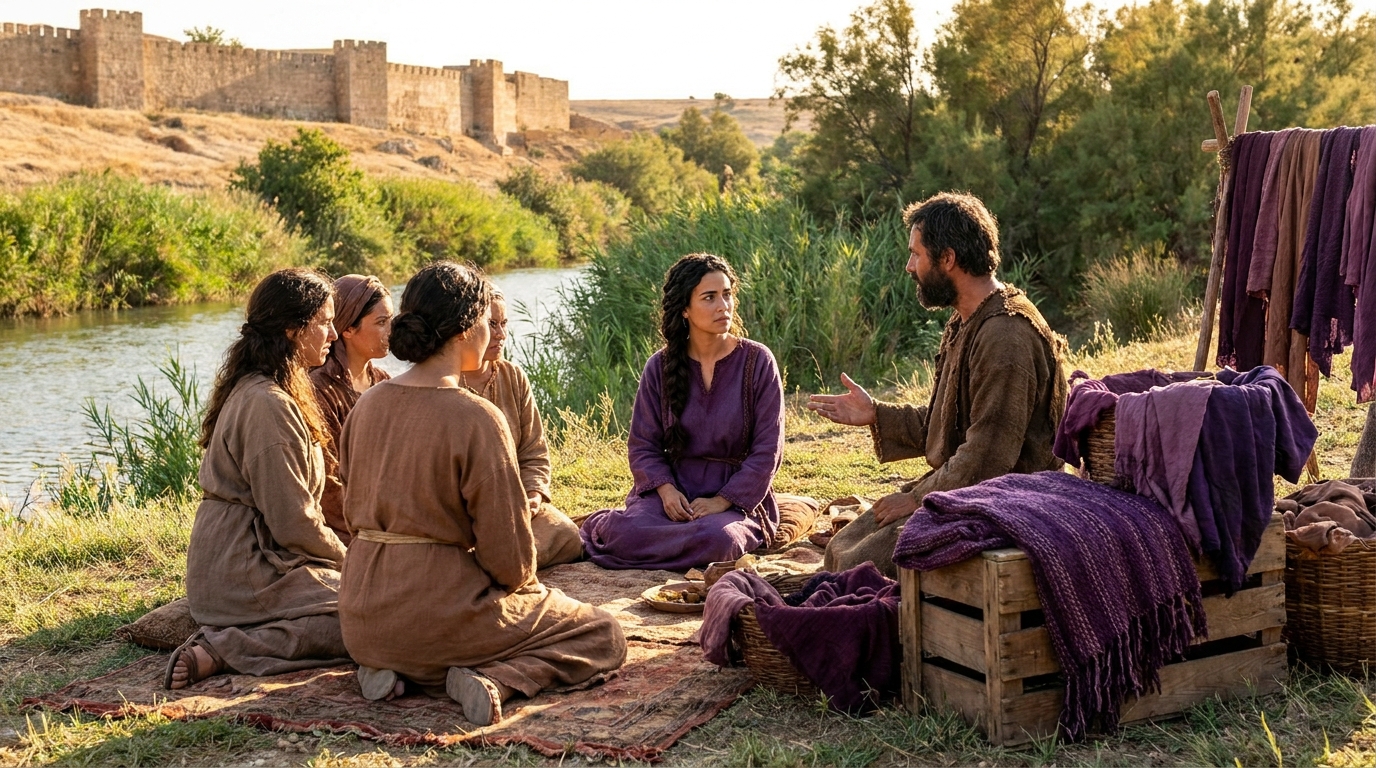
Instead, on a quiet Sabbath morning beside the Gangites River outside the gates of Philippi, Paul met a group of praying women—and God opened the heart of a prosperous textile entrepreneur named Lydia. Like a living New Testament portrait of the Proverbs 31 woman who makes and sells fine linen garments (Proverbs 31:24), Lydia used her business acumen, her household leadership, and her spacious home to launch the Philippian church.
📖 Key Biblical Passages on Lydia of Philippi (Acts 16)
- Acts 16:9–13: Following the vision of the Macedonian call, Paul, Silas, Timothy, and Luke travel to the Roman colony of Philippi and seek out a riverside place of prayer on the Sabbath.
- Acts 16:14: Lydia, a worshipper of God from the city of Thyatira who deals in costly purple cloth, listens intently as the Lord opens her heart to respond to Paul’s gospel message.
- Acts 16:15: Baptized alongside her entire household, Lydia warmly insists that the missionary team stay as guests in her home.
- Acts 16:40: After Paul and Silas are miraculously freed from the Philippian jail, they return directly to Lydia’s house—now the gathering place of the newly born Philippian church—to encourage the believers.
4 Transformative Faith Lessons from Lydia in the Bible
1. Guarding Your Sabbath Quiet Time Even With a Busy Schedule (Acts 16:13–14)
Look at Lydia’s profession in Acts 16:14: she was a merchant dealing in purple cloth from the Asian trade city of Thyatira (modern-day Akhisar in western Turkey). In the first-century Roman Empire, purple dye—extracted either from the murex sea snail or prized madder root in Thyatira’s famous textile guilds—was worth its weight in silver and worn by senators, magistrates, and royalty. Operating an international import branch in the busy Roman colony of Philippi required sharp intelligence, capital, and constant management.
Yet where do we find this busy executive on the Sabbath morning? Not tallying invoices in the marketplace! Even though Philippi lacked the ten Jewish men required to form an official synagogue, Lydia walked roughly 2 kilometres outside the city gate to the riverbank to gather with other women for prayer. Because she protected her weekly Sabbath rest and prayer rhythm, she was in the exact right place when the Gospel arrived.
2. “The Lord Opened Her Heart”: How Grace Meets a Listening Ear (Acts 16:14)
Notice the two actions woven together in Acts 16:14: first, Lydia was listening attentively as Paul spoke; second, the Lord opened her heart to pay attention and respond to the message of Christ.
Spiritual transformation is never something we force through sheer willpower; it is a miracle of grace that happens when we position ourselves to listen to God’s Word—just like the “good soil” in the Parable of the Sower. Notice also how this comforts us when we pray for unsaved loved ones: no human heart is too busy or too independent for the Lord to gently unlock from the inside out!
3. When God Changes Your Heart, Your Whole Household Is Blessed (Acts 16:15)
As the head of an established commercial estate, Lydia’s “household” (Greek: oikos) would have included extended family members, domestic servants, and textile workshop employees who traveled with her from Thyatira. The very same day the Lord opened Lydia’s heart, she shared the good news with everyone under her roof—and her entire household was baptized in the river alongside her!
Notice that Lydia didn’t have to close her business to become a missionary. Instead, her business household immediately became her mission field.
4. Turning Your Home Into a Sanctuary for the Body of Christ (Acts 16:15, 40)
The moment Lydia rose from the baptismal waters of the river, she used her natural gift of persuasion for the kingdom—urging Paul, Silas, Timothy, and Luke to come stay at her spacious home so she could house and feed their missionary team (Acts 16:15).
Days later, after Paul and Silas were beaten with rods, thrown into the inner dungeon of Philippi, and delivered by a midnight earthquake (Acts 16:22–39), where did they go the moment they were released from prison? Straight back to Lydia’s house (Acts 16:40), where the brothers and sisters of the brand-new Philippian church were already gathering! Every time you read the joyful Book of Philippians—where Paul thanks God for their partnership in the Gospel from the very first day until now (Philippians 1:3–5)—remember that the entire church began in the living room of one hospitable woman with an open heart and an open door.
🌿 A Quiet-Time Reflection & Breath Prayer for Today
Whether your daily work takes place in an office, a creative studio, a storefront, or at your kitchen table, invite the Lord to use your skills and your home for His glory:
- Inhale slowly: “Lord, thank You for opening my heart to receive Your grace…”
- Exhale in generosity: “…use my daily work, resources, and home to bless Your people.”
Start each workday anchored in Scripture and prayer with our 30-Day Christian Prayer Journals or our Walking in Grace 52-Week Devotional.
Read Next: Warrior Woman — Forging a Legacy of Faith With Proverbs 31 →Frequently Asked Questions About Lydia in the Bible
What does it mean that Lydia was a “worshipper of God” before meeting Paul?
In the Book of Acts, the phrase “worshipper of God” (or “God-fearer”) refers to Gentiles who had turned away from Greco-Roman pagan idols to worship the one true God of Israel, observe the Sabbath, and study the Hebrew Scriptures—preparing Lydia’s heart to immediately recognize Jesus as the promised Messiah when Paul preached.
Why was Lydia’s hometown of Thyatira famous for purple cloth?
Ancient archaeological inscriptions discovered in Thyatira (located in the historical region of Lydia in Asia Minor) confirm that the city was a premier hub for the guild of wool-dyers, producing vivid “Turkish red” and royal purple dyes from the madder root as well as marine shell pigments.
How has Lydia’s example inspired the way you view your own daily work, business, or hospitality? Share your thoughts in the comments below!

