

Hi friend,
Are you currently standing in front of a problem in your life—a hardened family relationship, a financial hurdle, or a long-standing stronghold—that feels as tall, thick, and tightly barred as the stone walls of an ancient fortress?
Right after crossing the Jordan River into the Promised Land, the people of Israel ran headfirst into their first seemingly impossible obstacle: the fortified city of Jericho. Guarding the entrance to the central hill country of Canaan, Jericho was encircled by towering stone retaining walls nearly 2 metres thick and up to 9 metres high, with every gate bolted shut (Joshua 6:1).
Yet in Joshua chapters 5 and 6, God did not instruct Joshua to build siege ramps or battering rams. Instead, He gave Israel a battle plan centered on worship, quiet perseverance, and trusting God’s promise before a single stone moved.
📖 Key Biblical Passages: Joshua 5:13–6:25
- Joshua 5:13–15: Outside Jericho, Joshua encounters the Commander of the army of the Lord, removes his sandals on holy ground, and bows in worship.
- Joshua 6:1–5: The Lord declares in the past tense—“See, I have delivered Jericho into your hands”—and gives the seven-day marching instructions around the Ark of the Covenant.
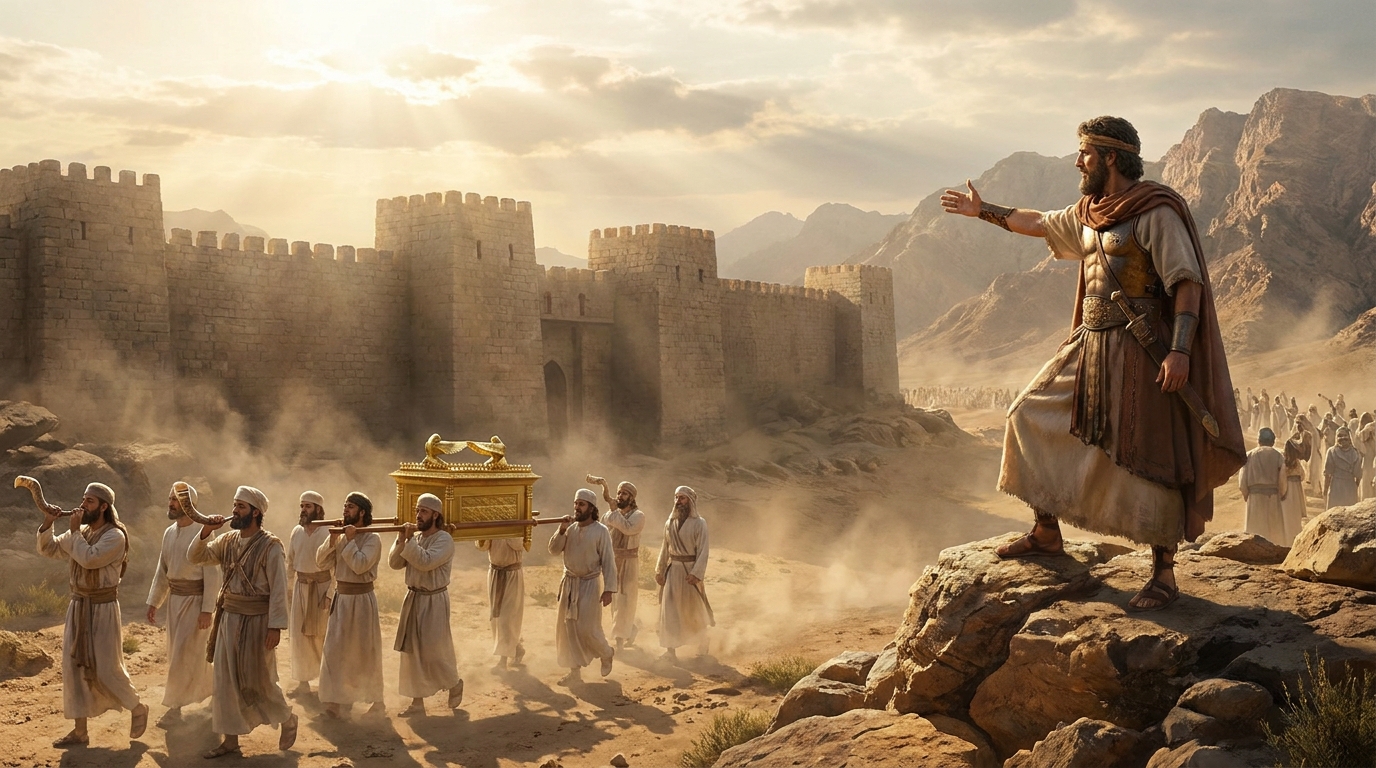
- Joshua 6:6–14: For six consecutive days, the priests blow ram’s horns while the people march around the city once each day in complete vocal silence.
- Joshua 6:15–25: On the seventh day, after marching around the city seven times and lifting a great shout at the sound of the trumpets, the walls collapse flat—while Rahab and her family are rescued safely as promised.
4 Transformative Faith Lessons from the Battle of Jericho
1. Surrender to the Commander Before You Face the Wall (Joshua 5:13–15)
The true turning point of the Battle of Jericho actually happens three verses before chapter 6 even begins! While scouting near Jericho in Joshua 5:13–15, Joshua looked up and saw a Man standing in front of him with a drawn sword in His hand. Walking up to Him, Joshua asked a very natural human question: “Are you for us or for our enemies?”
Listen carefully to the reply in verse 14: “Neither, but as commander of the army of the Lord I have now come.” Instantly recognizing a pre-incarnate appearance of the Lord (just as Moses was told to remove his sandals at the burning bush), Joshua fell facedown in worship! Before God ever brings down the walls in front of us, He invites us to stop asking Him to rubber-stamp our plans and instead bow in surrender to His leadership.
2. Why God Commanded Six Days of Marching in Silence (Joshua 6:10)
Look at the specific instruction Joshua gave the people for the first six circuits around Jericho in Joshua 6:10: while the seven priests blew the ram’s horns in front of the Ark of the Covenant, the people were commanded not to shout or even let a single word leave their lips until the seventh day!
Why did God put the entire camp on vocal mute for six days while walking around an intimidating stone wall? Remember what had kept their parents out of the Promised Land forty years earlier in Numbers 13–14: murmuring, complaining, and speaking words of panic about how tall the Canaanite walls were! Had the Israelites been allowed to chat while marching around Jericho on Day 2 or Day 4, someone inevitably would have whispered, “Look how thick those stones are—walking in circles isn’t doing a thing!” Guarding our tongues from complaining gives faith room to take root.
3. Persevering Through “Lap Six” When Nothing Looks Different Yet
According to Hebrews 11:30, it was “by faith the walls of Jericho fell, after the army had marched around them for seven days.”
Think about how much patience that required: Israel had to march around the city once a day for six days, and then seven times on the seventh day—a total of thirteen laps. After Lap 1, Lap 6, and even Lap 12, there wasn’t a single crack in the mortar! The wall looked just as immovable on the twelfth lap as it did on the first morning. In your own prayer life—much like Elijah sending his servant seven times to look for rain—never quit on Lap 6 just because you haven’t seen bricks falling yet. Every obedient lap of prayer is bringing you closer to God’s appointed hour.
4. Shouting Praise While the Wall Is Still Standing (Joshua 6:16, 20)
Notice the exact sequence in Joshua 6:16 and 6:20 on the final lap of the seventh day. Did the Israelites wait for the walls to crumble first and then cheer afterward? No—Joshua commanded them to shout because the Lord had given them the city, and while the walls were still standing in front of their eyes, the people lifted up a great shout of faith, and the stone ramparts collapsed flat!
Anyone can praise God after a problem is solved; biblical faith praises God on the authority of His promise while the wall is still standing in front of you. As we explore in our study on wearing the Armor of God in spiritual warfare, worship and obedience are the weapons God uses to pull down strongholds (2 Corinthians 10:4).
🌿 A Quiet-Time Reflection & Breath Prayer for Today
Whatever “Jericho wall” you are walking around in prayer this week, keep taking today’s lap of quiet obedience without giving in to discouragement:
- Inhale slowly: “Lord, I bow before You as the Commander of my life…”
- Exhale in praise: “…I thank You in advance that no wall is too high for Your power.”
Stay consistent in your daily laps of prayer with our printable 30-Day Christian Prayer Journals or our Walking in Grace 52-Week Devotional.
Read the Inside-the-Walls Companion: Rahab & the Scarlet Cord →Frequently Asked Questions About the Battle of Jericho
Why was the Ark of the Covenant carried at the center of the march?
Seven times in Joshua 6:4–13, the text emphasizes the Ark of the Covenant of the Lord accompanied by seven priests blowing ram’s horns (shofars—instruments of jubilee and worship rather than metal war bugles). Keeping the Ark at the center visibly reminded Israel that God’s presence, not human military might, was winning the victory.
How long did it take to walk around ancient Jericho?
Archaeological excavations at Tell es-Sultan (ancient Jericho) show that the heavily fortified bronze-age city mound covered roughly 3.6 to 4 hectares (with a perimeter of less than 1 kilometre), meaning the armed procession and priests could complete one circuit around the outer walls in about 20 to 30 minutes each morning.
Which lesson from Joshua 6—surrendering to the Commander, guarding your tongue from complaining, or praising God before the wall falls—speaks most directly to your current season? Share below!

