Hi friend,
Have you ever interceded for your child or a hurting loved one with such fierce, tearful urgency that you felt ready to knock on heaven’s door day and night until breakthrough came—even when heaven initially seemed silent?
Few forces on earth are as relentless as a mother praying for her child. Yet some of the hardest tests of our faith happen in the waiting room between our first desperate cry to God and the moment His answer arrives.
In Matthew 15:21–28 (and the parallel account in Mark 7:24–30), Jesus traveled roughly 50 kilometres northwest out of Galilee into the Gentile coastal district of Tyre and Sidon. There, a desperate Greek-speaking mother—whom Matthew calls a Canaanite woman and Mark identifies as a Syrophoenician woman—came crying out at His feet to save her demon-tormented daughter. What begins as one of the most puzzling conversations in the Gospels unfolds into a breathtaking portrait of persistent, humble faith.
📖 Key Biblical Passages: Matthew 15:21–28 & Mark 7:24–30
- Matthew 15:21–22: Withdrawing to the region of Tyre and Sidon, Jesus is approached by a Canaanite mother who addresses Him by His Messianic title: “Lord, Son of David, have mercy on me!”
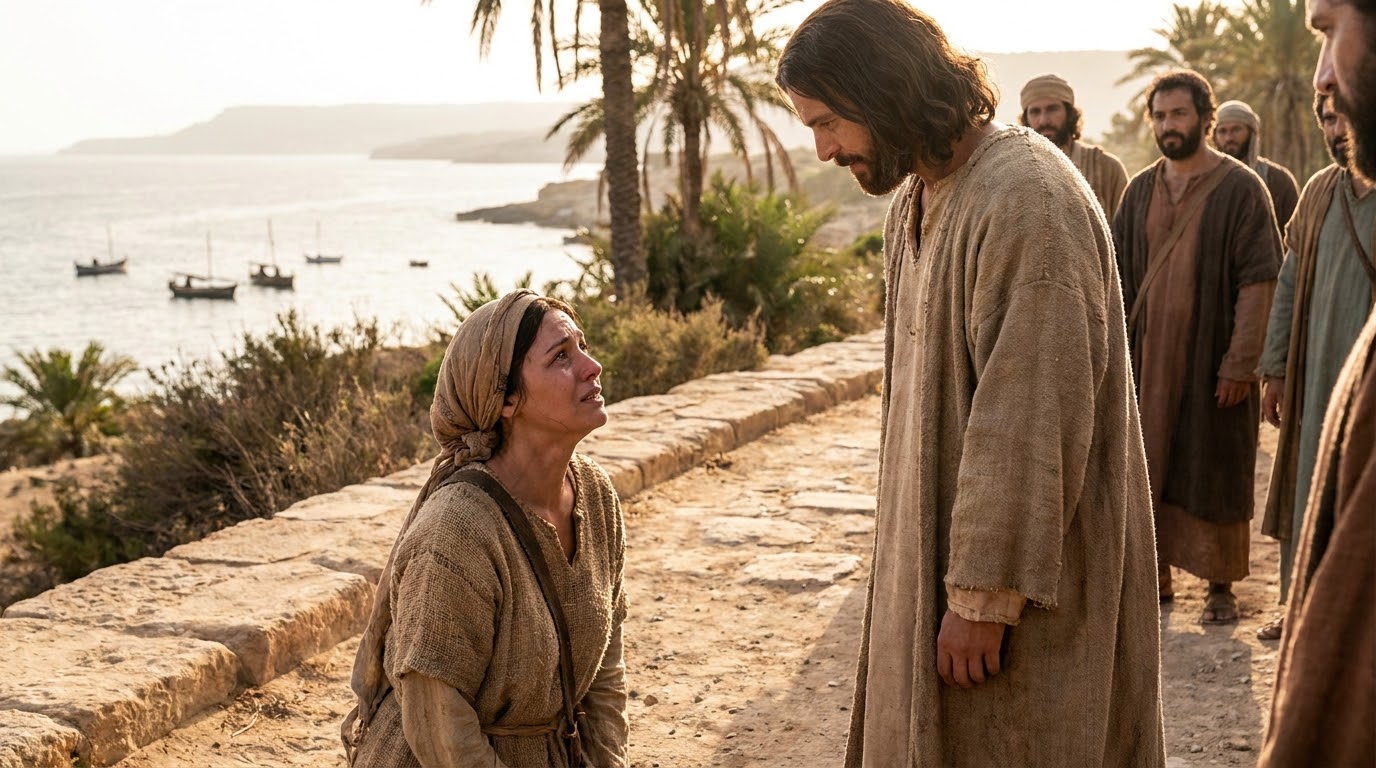
- Matthew 15:23–25: Tested through three seeming barriers—initial silence, the disciples’ irritation, and the mission priority to Israel—she kneels directly in front of Jesus and pleads: “Lord, help me!”
- Matthew 15:26–27: When Jesus speaks of the children’s bread and the household pets, she replies with humble, quick-witted trust that even the little dogs eat the crumbs falling from their master’s table.
- Matthew 15:28: Jesus commends her “great faith” and heals her daughter from a distance at that exact hour.
4 Transformative Faith Lessons from the Syrophoenician Woman
1. Why Jesus Walked 50 Kilometres Into Gentile Territory for One Mother
Before we look at the testing of this woman’s faith, zoom out and notice a detail that changes how you read the entire passage: why did Jesus walk all the way up into the pagan territory of Tyre and Sidon in Matthew 15:21 in the first place? Look across the whole chapter—He didn’t preach in a single synagogue there, didn’t address a crowd, and didn’t perform any other recorded miracle in that region. The moment He healed this woman’s daughter, He turned right around and walked back to the Sea of Galilee (Matthew 15:29)!
Just as He deliberately walked through Samaria at noon to meet the Samaritan woman at the well, Jesus took a multi-day journey on foot into Phoenicia specifically so this one heartbroken mother could find Him. Even when God feels silent at first, remember that He already crossed the distance to put Himself within reach of your cry.
2. Pressing Past Initial Silence and Discouraging Voices (Matthew 15:23–25)
Look at how the woman came to Jesus in Matthew 15:22: she didn’t bring a long list of personal merits; she simply made her daughter’s pain her own—crying out, “Have mercy on me, Lord, Son of David!” Yet in verse 23, Matthew records a startling line: “Jesus did not answer a word.” Meanwhile, the disciples grew annoyed and begged Jesus to send her away because she kept crying out behind them.
Why was Jesus silent at first? Not to push her away, but to draw out a deeper confession of faith right in front of His prejudiced disciples! Notice what she did in verse 25 when she heard the disciples trying to dismiss her: instead of retreating behind them, she walked right around the disciples, knelt face-to-face at Jesus’s feet in worship, and distilled her prayer down to three raw words: “Lord, help me!” (just like Peter’s three-word cry on the water). When you are cultivating a persistent prayer habit, never mistake a season of testing for a final “no.”
3. An Unoffendable Heart: Finding Infinite Grace in a Single Crumb (Matthew 15:26–27)
In Matthew 15:26, Jesus spoke a household proverb to test her heart: that it is not right to take the children’s bread and toss it to the dogs. In the original Greek, instead of using the harsh word for wild street scavengers (kyon), Jesus used the affectionate diminutive word kynarion—meaning “little household puppies or family pets” that sit right beneath the family dining table.
A proud heart would have bristled with offense, stood up, and stormed out of the room. Instead, this mother caught the tender opening inside Jesus’s parable! Agreeing humbly in verse 27, she pointed out that if Gentiles were like the little pets under the table, then she didn’t need to steal the children’s loaf—she had a rightful place right beneath the Master’s table, and one single crumb of grace falling from the hand of the Son of God was more than enough to heal her little girl completely!
4. Only Two People in the Gospels Were Told They Had “Great Faith” (Matthew 15:28)
Have you ever noticed who received the highest compliment Jesus ever gave regarding faith? Across all four Gospels, Jesus told His own disciples several times that they had “little faith.” Yet there are only two individuals in the entire New Testament whom Jesus looked in the eye and commended for having “great faith”:
- The Roman Centurion in Capernaum who interceded for his paralyzed servant from a distance (Matthew 8:10).
- This Syrophoenician mother who interceded for her afflicted daughter from a distance (Matthew 15:28).
Both were Gentiles, both pleaded for someone they loved who couldn’t come to Jesus on their own, and both believed that Jesus could heal with a single spoken word without even stepping inside their house! When she walked back through her front door (Mark 7:30), she found her daughter resting peacefully on the bed, completely whole.
🌿 A Quiet-Time Reflection & Breath Prayer for Today
If you are praying fervently for a child, grandchild, or family member today, refuse to let delay or discouragement pull you away from the Master’s table:
- Inhale slowly: “Lord, I kneel at Your feet with a humble, persistent heart…”
- Exhale in trust: “…even one crumb of Your mercy is enough to heal and restore my home.”
Lift up your family by name each morning inside our printable 30-Day Christian Prayer Journals or walk through Scripture with our Walking in Grace 52-Week Devotional.
Read Next: Hannah’s Prayer — Finding Peace When Waiting on God →Frequently Asked Questions About the Syrophoenician Woman
Why does Matthew call her a “Canaanite” while Mark calls her “Syrophoenician”?
Both descriptions are completely accurate for their respective audiences! Writing primarily for Jewish believers, Matthew used the ancient Old Testament term “Canaanite” to remind his readers that God’s mercy was reaching Israel’s oldest historical rivals (just like Rahab in Jericho). Writing for Roman and Gentile readers, Mark used the contemporary first-century geopolitical term “Syrophoenician”—indicating a native of Phoenicia within the Roman province of Syria.
What did Jesus mean in Mark 7:27 by “First let the children eat all they want”?
In Mark’s account, Jesus included the word “First”—signaling that in God’s redemptive timeline, the Gospel was brought first to the covenant people of Israel (Romans 1:16: “first to the Jew, then to the Gentile”), and would soon overflow from that table to bless every nation on earth.
What stands out to you most about this mother’s refusal to give up when interceding for her daughter? Share your thoughts and prayer requests in the comments below!