Hi friend,
Have you ever wondered why the Book of Revelation follows up the 7 Seals in chapters 6–8 with the 7 Trumpets in chapters 8–11—and why God uses the specific symbol of a trumpet blast before the final return of Christ?
In the biblical world, a trumpet was never blown silently in a corner. Whether crafted from hammered silver (Numbers 10:1–10) or a curved ram’s horn shofar like those blown by the priests at Joshua’s Battle of Jericho, a trumpet had three unmistakable purposes: to wake up a sleeping camp, to warn of approaching danger so people could take shelter, and to announce the coronation of the King.
Continuing our walkthrough of Understanding the Book of Revelation: A Guide for Women, let’s explore how the 7 Trumpets in Revelation 8–11 serve as heaven’s merciful wake-up calls to a rebellious world while guaranteeing the protection of every believer sealed by God.
📖 Quick Timeline: All 7 Trumpets in Revelation (Chapters 8–11)
- The First Trumpet (Revelation 8:7): Hail and fire mixed with blood → One-third of the earth’s trees and green grass are burned (echoing the 7th plague of Exodus).
- The Second Trumpet (Revelation 8:8–9): A blazing mountain cast into the sea → One-third of the oceans, sea life, and ships are struck (echoing the 1st plague of Exodus).
- The Third Trumpet (Revelation 8:10–11): The falling star named Wormwood → One-third of the freshwater rivers and springs turn bitter.
- The Fourth Trumpet (Revelation 8:12–13): Darkening of the heavens → One-third of the sun, moon, and stars are darkened (echoing the 9th plague of Exodus).
- The Fifth Trumpet / First Woe (Revelation 9:1–12): Locusts from the Abyss → Spiritual torment unleashed for five months, yet strictly forbidden from touching anyone bearing the seal of God on their forehead.
- The Sixth Trumpet / Second Woe (Revelation 9:13–21): Release of the four bound angels at the Euphrates → A massive mounted force strikes one-third of unrepentant humanity, followed by the interlude of the little scroll and Two Witnesses in chapters 10–11.
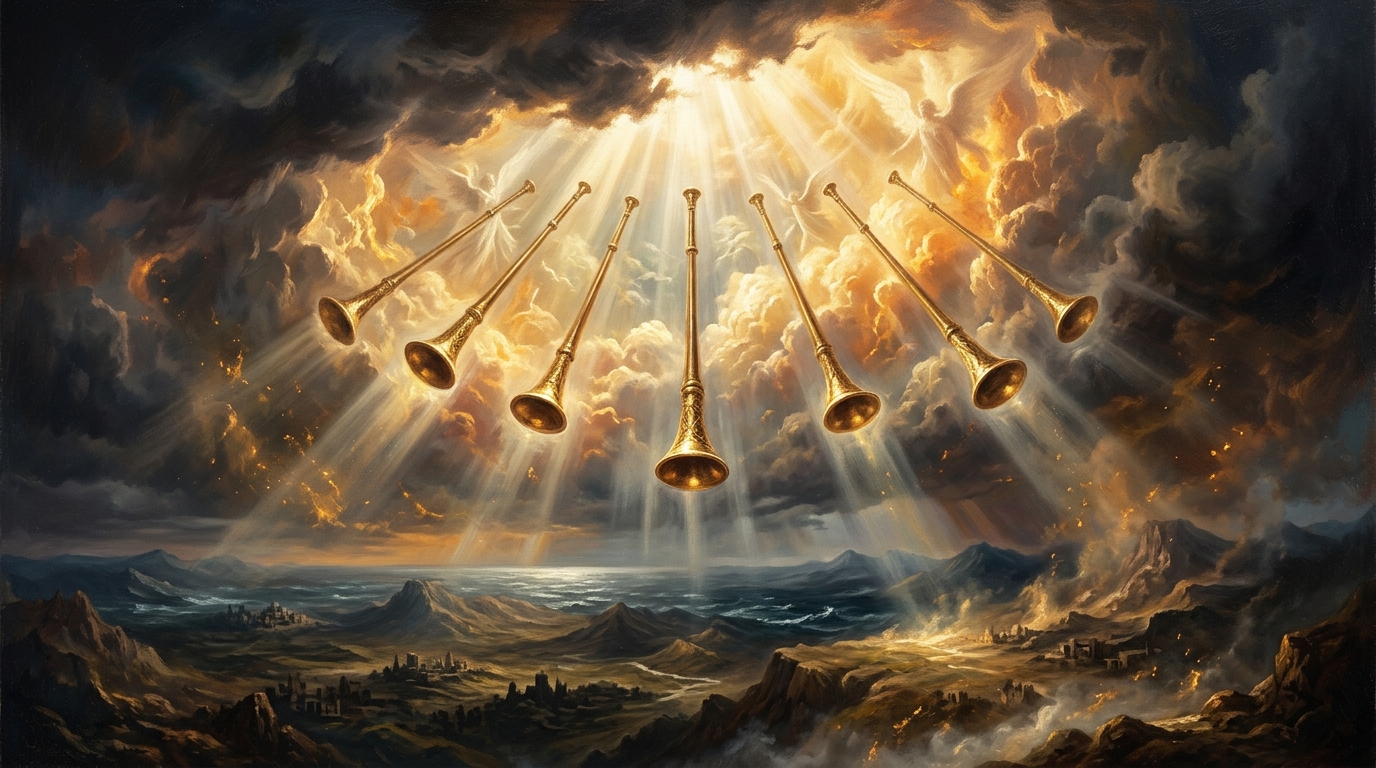
- The Seventh Trumpet / Third Woe (Revelation 11:15–19): The Coronation Blast → Heaven erupts in worship as the kingdom of the world officially becomes the eternal kingdom of our Lord and of His Christ!
4 Comforting Biblical Truths About the 7 Trumpets
1. Why the First Four Trumpets Echo the Plagues of Exodus—And Why Only “One-Third” Is Struck (Revelation 8:7–12)
As you read through the first four trumpet blasts in Revelation 8:7–12—affecting the land and trees, the salt seas, the freshwater rivers, and the lights in the sky—two patterns jump off the page immediately:
- Echoes of the First Exodus: Hail mingled with fire (Exodus 9:24), water turned to blood (Exodus 7:20), bitter waters (Exodus 15:23), and supernatural darkness (Exodus 10:21) are direct callbacks to the miraculous signs of Moses in the Book of Exodus! Just as God judged the false idols of Egypt to set His people free at the Red Sea, He exposes the false security of a fallen world before bringing His bride home.
- The Merciful “One-Third” Restraint: Notice that twelve separate times in chapter 8, the text repeats the fraction “a third”! Unlike the final bowls of chapter 16 (which strike the whole), the trumpets are deliberately restrained by two-thirds. Why? Because a trumpet blast is a warning alarm—giving hard hearts opportunity after opportunity to wake up and turn back to God before final judgment arrives.
2. The Fifth Trumpet’s Shield: Why the Sealed of God Cannot Be Touched (Revelation 9:1–4)
The last three trumpets (Trumpets 5, 6, and 7) are set apart from the first four as three solemn “woes” because the focus shifts from the physical environment to the spiritual battle over human hearts. When the fifth angel blows his trumpet in Revelation 9:1–3, smoke rises from the shaft of the Abyss and a swarm of spiritual locusts emerges.
Before that imagery can frighten a single believer, read Revelation 9:4 closely! Right at the front of the command, they are strictly told not to harm the grass of the earth or any tree, “but only those people who do not have the seal of God on their foreheads.”
Think about the ironclad security of that boundary: just as the destroying angel in Egypt could never cross a doorframe marked with the blood of the Passover lamb, dark spiritual forces have zero permission to touch a soul sealed by the Holy Spirit (Ephesians 1:13–14). Walking daily in the Armor of God means resting in the certainty that you are marked as God’s treasured possession.
3. The Interlude of Chapter 10: The Little Scroll That Is Sweet and Bitter (Revelation 10:8–11)
Just as Revelation paused between the sixth and seventh seals (in chapter 7) to remind us of God’s protection, the narrative pauses again between the sixth and seventh trumpets across Revelation 10:1–11:14.
In Revelation 10:8–10, John is instructed to take a little open scroll from the hand of a mighty angel and eat it (echoing the prophet Ezekiel in Ezekiel 3:1–3). When John places the scroll in his mouth, it tastes as sweet as honey—yet once he swallows it, his stomach turns bitter.
Every compassionate Christian woman understands that bittersweet tension when reading end-times prophecy: God’s Word is sweet as honey to our mouths because it promises that Jesus wins, tears will be wiped away, and righteousness will reign forever; yet it brings a heavy ache to our stomachs when we think of stubborn hearts (Revelation 9:20–21) that refuse God’s mercy—motivating us to pray fervently for our unsaved loved ones and neighbors today.
4. The Seventh Trumpet: The Hallelujah Chorus of Revelation 11:15
Have you ever sung or listened to the soaring Hallelujah Chorus from Handel’s Messiah? The central lyrics of that timeless anthem come word-for-word from the blowing of the seventh trumpet in Revelation 11:15!
The moment the seventh angel sounds his horn, loud voices break forth in heaven announcing that the kingdom of the world has officially become the kingdom of our Lord and of His Messiah, and He will reign forever and ever! And as the twenty-four elders fall on their faces in worship, heaven’s temple opens to reveal the Ark of His Covenant (Revelation 11:19)—the ultimate symbol that God has kept every single covenant promise He ever made to His people, ushering in the glorious reign of Christ.
🌿 A Quiet-Time Reflection & Breath Prayer for Today
Let the seventh trumpet’s promise quiet your heart today—knowing that every broken system of this world is giving way to the eternal, unshakeable kingdom of Jesus:
- Inhale slowly: “Lord Jesus, I am sealed by Your Spirit and safe in Your covenant…”
- Exhale in worship: “…the kingdoms of this world belong to You, and You will reign forever.”
Intercede for your family and record God’s promises inside our printable 30-Day Christian Prayer Journals or our Walking in Grace 52-Week Devotional.
Return to the Hub: Understanding the Book of Revelation for Women →Frequently Asked Questions About the 7 Trumpets
What is “Wormwood” in the Third Trumpet (Revelation 8:10–11)?
In the Old Testament (such as Jeremiah 9:15 and Lamentations 3:15, 19), wormwood (Artemisia absinthium) was a desert shrub known for its intensely bitter, toxic sap, used prophetically as a symbol of the bitter sorrow that follows idolatrous rebellion against the Living Water of God.
Is the Seventh Trumpet of Revelation 11:15 the same as the “last trumpet” in 1 Corinthians 15:52?
Christians hold two main perspectives on this question (explored further in our guide on What Is the Rapture? A Gentle Biblical Perspective): pre-tribulational scholars distinguish Paul’s “last trumpet” (the final trumpet call assembling the church at the Rapture) from the seventh judgment trumpet of Revelation 11:15, while mid-tribulational and post-tribulational scholars connect the two. Regardless of the timeline view held, all believers agree that the seventh trumpet heralds the visible triumph of Christ’s kingdom!
Which part of the 7 Trumpets—the merciful one-third restraint, the protective seal of Revelation 9:4, or the triumphant song of the seventh trumpet in 11:15—encourages your faith most today? Share below!