


Hi friend,
In a world characterized by surface-level connections, fleeting social media followers, and relationships that dissolve at the first sign of inconvenience, genuine, soul-deep loyalty is a rare treasure.
When life hits us with sudden grief, financial catastrophe, or relational betrayal, we often find ourselves retreating into isolation. We convince ourselves that nobody truly cares, or that we are a burden to those around us.
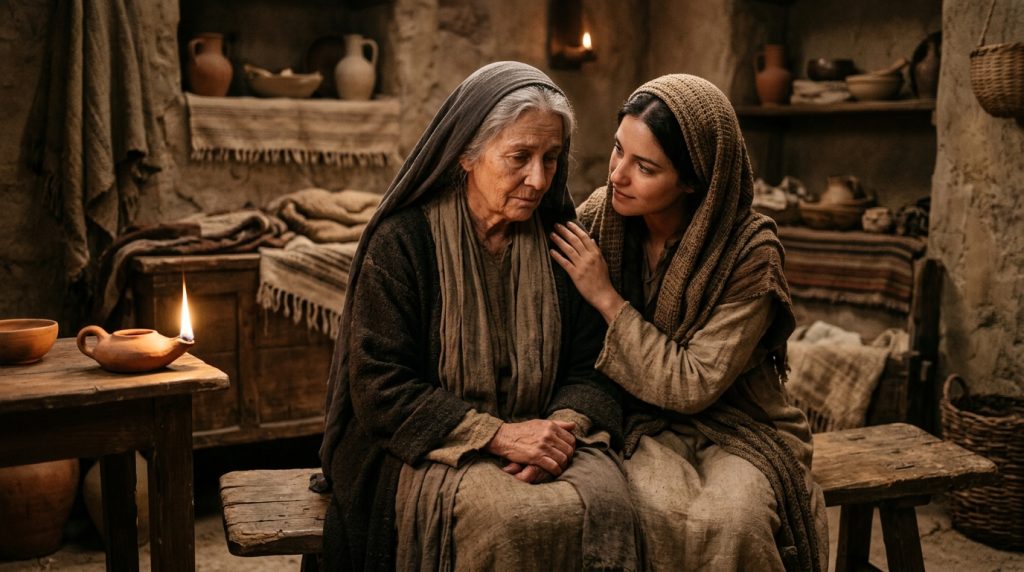
The Old Testament Book of Ruth opens against a backdrop of devastating tragedy. In the pagan land of Moab, Naomi loses her husband and both of her sons within ten years. Destitute, aging, and heartbroken, Naomi urges her daughters-in-law to return to their families. But Ruth makes a vow of covenant devotion that remains one of the most stunning declarations of loyalty ever spoken: ‘Where you go I will go, and where you lodge I will lodge. Your people shall be my people, and your God my God.’
Today, let’s explore 4 transformative faith lessons from Ruth and Naomi, discovering how God weaves unbreakable community and redemption through seasons of intense loss.
“For where you go I will go, and where you lodge I will lodge. Your people shall be my people, and your God my God.” — Ruth 1:16 (ESV)
1. The Power of Hesed: Covenant Love in Action
The central theological heartbeat of the Book of Ruth is the Hebrew concept of Hesed (חֶסֶד)—unfailing, covenantal, self-sacrificing loving-kindness. Hesed is love that goes beyond legal obligation; it is loyalty chosen freely in the face of cost.
Ruth was a Moabite widow with no social standing, no financial safety net, and no guarantee of remarriage in Israel. Yet, motivated by Hesed, she chose to bind her future to an elderly, grieving widow.
True biblical community isn’t built when life is convenient; it is forged when we choose to show up for others in their darkest valleys. By practicing grace, empathy, and forgiveness, our relationships reflect the unconditional love of Christ.
2. Grieving Honestly Without Abandoning Community
When Naomi returned to Bethlehem, the town was stirred, but Naomi said: ‘Do not call me Naomi; call me Mara, for the Almighty has dealt very bitterly with me. I went away full, and the Lord has brought me back empty’ (Ruth 1:20-21).
Naomi did not sugarcoat her pain. She named her grief ‘Mara’ (meaning bitter). Yet notice what she did: she returned to Bethlehem (the ‘House of Bread’) and stayed connected to her community, with Ruth by her side.
God welcomes your honest lament. You do not have to pretend everything is fine when your heart is shattered. But like Naomi, don’t grieve in isolation—allow godly sisters and brothers to walk beside you through the valley.
3. Faithfulness in the Ordinary Gleaning Fields
When Ruth arrived in Bethlehem, she didn’t sit waiting for a miracle to fall from the sky. She humbled herself and went out to glean leftover barley heads behind the harvesters in the hot sun to feed herself and Naomi (Ruth 2:2).
Scripture notes that she ‘happened’ to come to the field belonging to Boaz. What appeared to be random chance was actually God’s invisible providence directing her footsteps. As we explore in our study on the lessons from Ruth and Boaz, God often orchestrates your greatest breakthrough while you are simply being faithful in small, unglamorous daily tasks.
4. The Kinsman-Redeemer: God Restores What the Swarm Has Eaten
In ancient Israel, a Go’el (Kinsman-Redeemer) was a relative who stepped in to buy back lost family land and marry a childless widow to preserve the family line. Boaz acted as the redeemer for Ruth and Naomi, marrying Ruth and providing a son named Obed—who became the grandfather of King David, placing Ruth directly in the genealogy of Jesus Christ (Matthew 1:5).
At the end of the book, the women of Bethlehem rejoice with Naomi, saying: ‘He shall be to you a restorer of life and a nourisher of your old age’ (Ruth 4:15). God did not just restore what was lost; He wove Naomi and Ruth into the eternal story of salvation. No matter how empty your hands feel today, Jesus is your ultimate Kinsman-Redeemer.
Anchor Your Daily Walk in God’s Grace
Are you looking for a gentle, structured way to deepen your quiet time without feeling overwhelmed or falling into spiritual guilt? Download our Free 30-Day Christian Prayer Journal to start cultivating quiet daily communion with God, or explore our flagship 52-Week Prayer Journal & Devotional—designed for busy Christian women seeking peace over pressure.
➔ ACCESS YOUR 52-WEEK PRAYER JOURNAL & DEVOTIONAL
Study Companion – Recommended reading
Affiliate Disclosure: As an Amazon Associate, Grace Filled Pathways earns from qualifying purchases. When you purchase through links on our site, we may earn an affiliate commission at no extra cost to you.

ESV Single Column Journaling Bible (Floral Cloth Edition)
Best for Verse Mapping & Margin NotesFeatures high-quality cream paper with 2-inch ruled margins, giving you ample room to record character studies on Ruth, prayer reflections, and personal study insights.
Why We Love It: Wide 2-inch ruled margins and single-column layout make it effortless to write notes alongside Scripture, while the floral cloth cover brings a warm aesthetic to your quiet time routine. (Note: single-column margins make for a slightly thicker physical Bible).
Daily Breath Prayer:
Inhale: You are my faithful Kinsman-Redeemer
Exhale: I trust Your timing and provision
With grace and gratitude,
Sister Grace Shepherd

